Continued from Part 1
In keeping with its humble origins, the funerary architecture of Holy Cross lacks the grandeur notable in other large Detroit cemeteries, whether they be Catholic or non-Catholic. The presence of the surrounding slag heaps makes the cemetery feel like a quiet, green sanctuary for those who have gone before. Holy Cross’s one small mausoleum is very spartan in design with a simple marble door protecting the occupants, Emil and Gertrude Handloser.
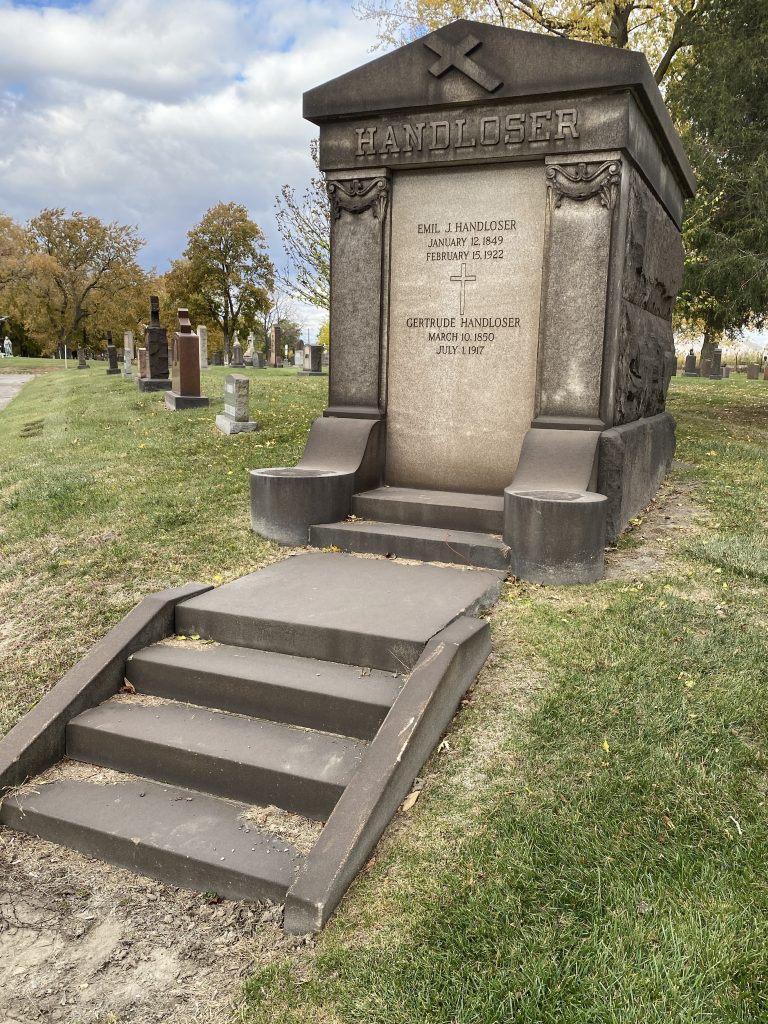
Emil immigrated from Germany and became a land developer and businessman in the village of Delray. They were the proprietors of Handloser Hall, a well-known Jefferson Avenue event venue, best known for hosting high-profile boxing matches around the turn of the 20th century[i][ii]. Handloser Hall was the launchpad for noted Canadian prizefighter Tommy Burns. Born Noah Brusso, Burns started his career with several bouts at Detroit area venues, including Handloser Hall. Eventually, he became the world heavyweight champion (despite being a middleweight) in 1906 and had a title reign lasting almost 3 years, finally losing the title to the immortal Jack Johnson. The hall was also a popular location for local political rallies and speeches, often combined with vaudeville-type entertainment.[iii]
Near the Handloser Mausoleum stands the monument to the Nykiel family.
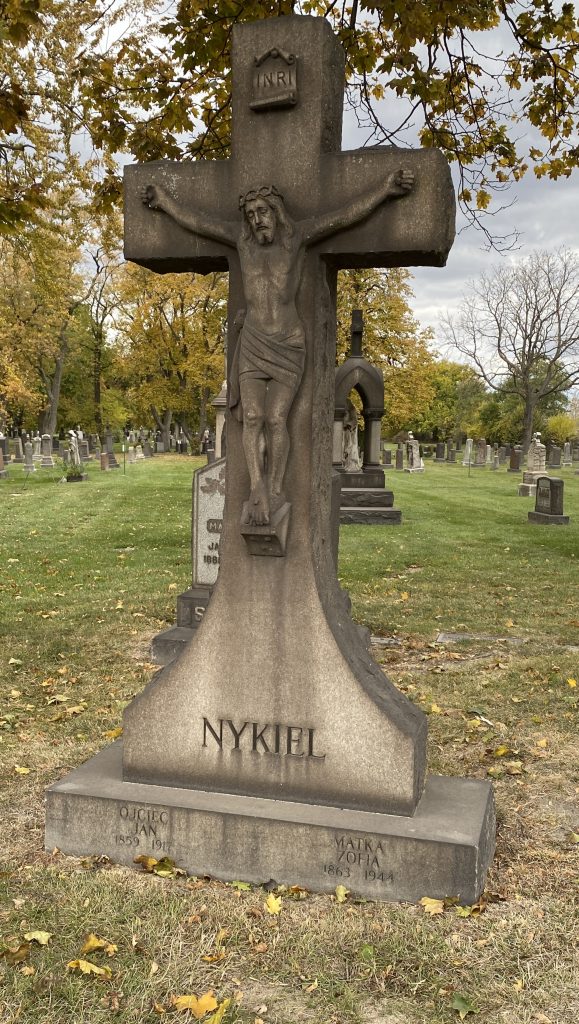
August Nykiel was involved in the bootlegging trade, a profession which ultimately led to his demise. Gus, or “big hearted Gus” as he was often called, was referred to in the Detroit Free Press as “one of the wealthiest of the downriver barons of bootleg,”[iv] also owning a local football team called the Tigers. On June 27, 1928, Nykiel was tending bar at his saloon on West Jefferson Avenue when two men called him outside. Gus stepped out the door and engaged in an argument with the two strangers, one of whom pulled a gun and fired five times. River Rouge constable Edward McPherson, present in the bar on police business, gave chase, firing on the two assailants and killing one of them, a Chicago-based mobster named Mike Dipisa. McPherson was shot in the jaw, an innocent bystander was shot in the finger, while Nykiel died on the way to Delray Industrial Hospital.[v] The remaining fugitive, James Zanetti, was apprehended but was later acquitted of Nykiel’s murder when the key witness, Gus’s brother, was “unavailable” in Ontario, beyond the easy reach of Michigan courts (and Zanetti’s associates).[vi][vii] Nykiel’s funeral was one of Detroit’s most elaborate of the time, spanning the west side from his home on Oakman Avenue to St. John Cantius church in Delray to his burial at Holy Cross. It was noted that the majority of the hundreds of mourners were women, and many of Nykiel’s “business” associates were absent, keeping a low profile given Gus’s violent death and the heavy Detroit Police presence.[viii] There are other residents of Holy Cross who met violent ends, but for one family, the tragedy only started with their unfortunate demise.
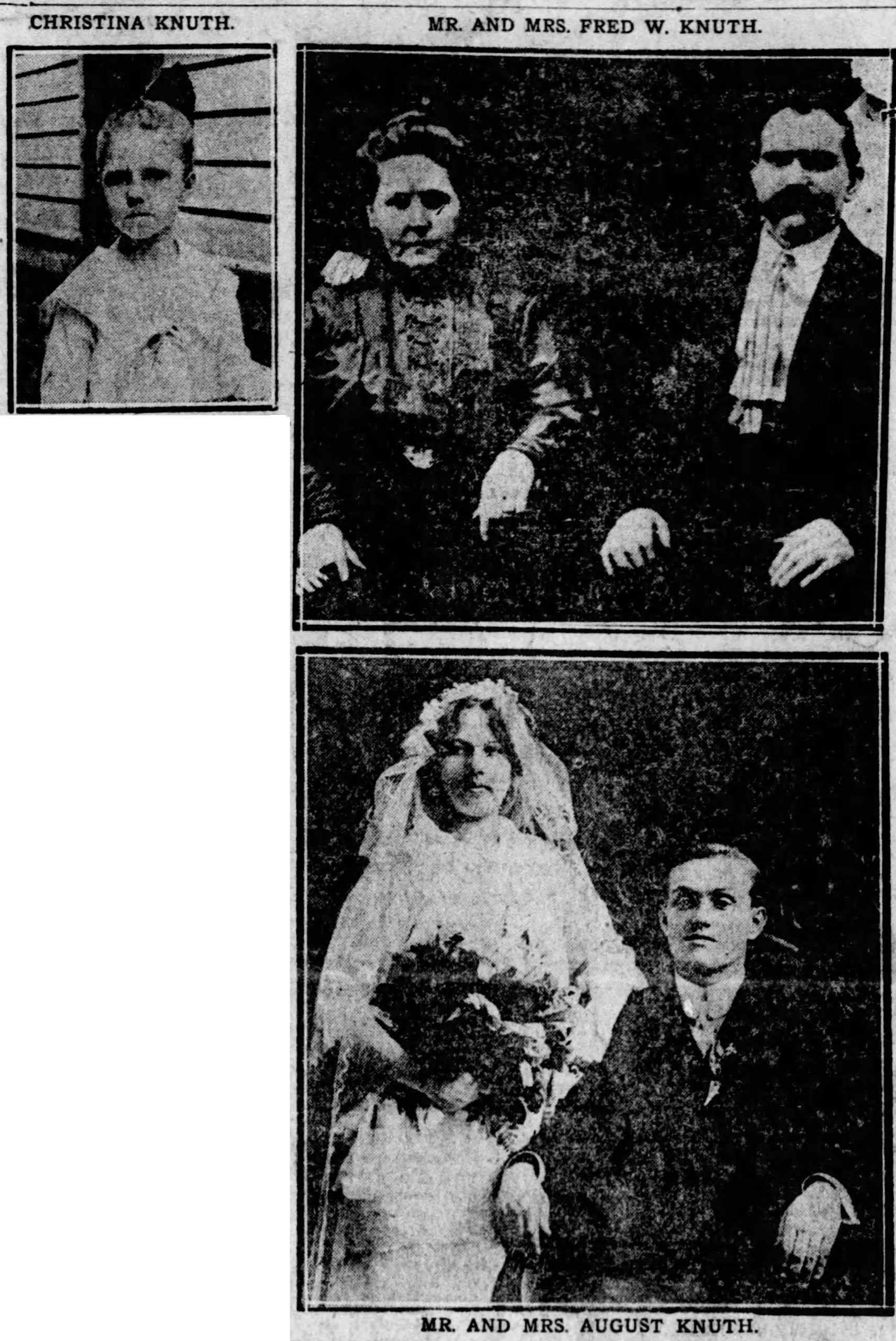
A day trip by automobile in 1916 was an occasion, and for the Knuths it must have been exciting to get out to the country to visit their friends the Wenzels. Fortunately, their son August’s friend, Harry Fleming, owned a Cadillac touring car and agreed to drive father Frederick Knuth, wife Julia, daughter Christina, August, and his wife Frances to their friends’ farm in Canton Township.
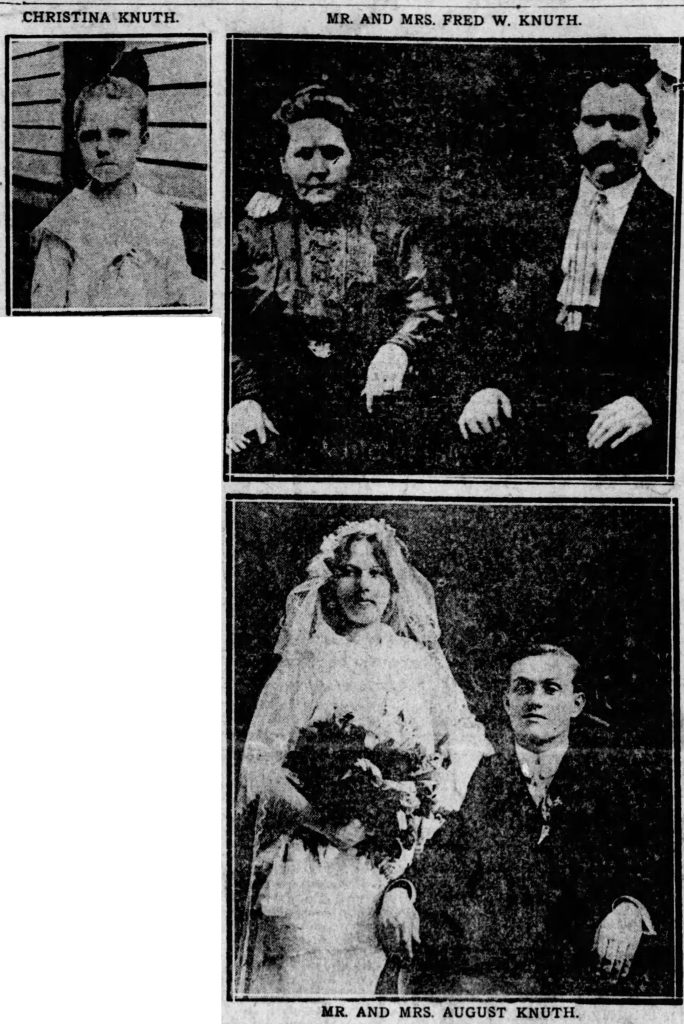
Tragedy struck, however, when their vehicle was broadsided by a Detroit United Railway train bound for Detroit just off Michigan Avenue (near the present-day Ford Wayne assembly plant). All six occupants of the Cadillac were killed instantly.[ix] For some reason, the justice of the peace in Wayne took control of the situation rather than calling in the Wayne County Coroner, the standard practice, and released the remains of the Knuth family to a Detroit undertaker without consulting the family. The undertaker took the five sets of remains to his mortuary and refused to release them to the family even when they came with a court order. After 3 days, to avoid the Knuth family and their accompanying Wayne County sheriff’s deputy, the unscrupulous undertaker put the five sets of mangled remains in three caskets and, in effect, shopped them around to multiple local cemeteries. Eventually, Evergreen Cemetery agreed to take them and buried the remains with no mourners or ceremony.[x] At the same time, the Knuth family was in hot pursuit of the underhanded undertaker with the court order and their legal muscle. Unfortunately, in their mad dash across the city they always seemed to be one cemetery behind and didn’t arrive at Evergreen until the burial had been largely completed. Evergreen proceeded to exhume the Knuths’ remains and release them to the family’s funeral director of choice. Their funeral, this time with five caskets, filled St. Boniface church to overflowing with both genuine mourners and the morbidly curious. The sad cortege proceeded to Holy Cross “where, after many rides to cities of the dead, the poor, battered bodies of Fred Knuth and his companions in death at last found a resting place.” Their graves in Holy Cross’s Section G are unmarked. Harry Fleming was interred at Mount Olivet Cemetery after his funeral at St. Vincent’s Church.[xi] The intentions of the deceitful undertaker are not clear, whether he was going to attempt to extort money from the family in exchange for their loved ones’ remains or for some other purpose, but in the end he was given the choice of a $50 fine or 30 days in jail for his “ghoulish behavior,” both of which were nowhere near adequate given the nature of his actions, per the judge. He chose the fine.[xii] Many of Holy Cross’s residents, however, never achieved this kind of notoriety, but nevertheless led important lives that helped build Detroit’s west side.
End of Part 2
About the Authors
Gavin Swantick is a local historian with several articles published in magazines such as Michigan History. He has a master’s degree in Anthropology from Wayne State University and has worked in many local museums.
Steve Swantick is a retired automotive engineer who grew up on Woodmere Avenue in Southwest Detroit. He has a strong interest in local history and genealogy, and has been fortunate to collaborate with his son, Gavin, on several projects. Steve’s maternal great-great-grandfather, Antoni Skoczek, was one of the founders of “Dziennik
[i] Raymo p. 42
[ii] “Delray to Reopen to Boxing Game.” Detroit Free Press, February 11, 1904.
[iii] “Delray Hears Mayor Codd.” Detroit Free Press, February 8, 1906.
[iv] “Slain Bootleg King Is Buried.” Detroit Free Press, July 3, 1928.
[v] “Lays Death of Two to Rum, Crash.” Detroit Free Press, June 29, 1928. P. 1, 3
[vi] “Freedom For Jim Zanetti.” Detroit Free Press, September 13, 1928.
[vii] “Nykiel’s Brother Is in Canada.” Detroit Free Press, September 9, 1928.
[viii] “Slain Bootleg King Is Buried.” Detroit Free Press, July 3, 1928.
[ix] “Six Persons Die as Auto and Interurban Car Meet in Collision Near Wayne.” Detroit Free Press, July 29, 1916.
[x] “No Ceremony at Burial of Dead.” Detroit Free Press, August 1, 1916.
[xi] “Grief-Stricken Kin of Wayne Wreck Victims Collapse at Funeral.” Detroit Evening Times, August 3, 1916.
[xii] “Undertaker’s Action Is Termed Ghoulish.” Detroit Free Press, August 2, 1916.