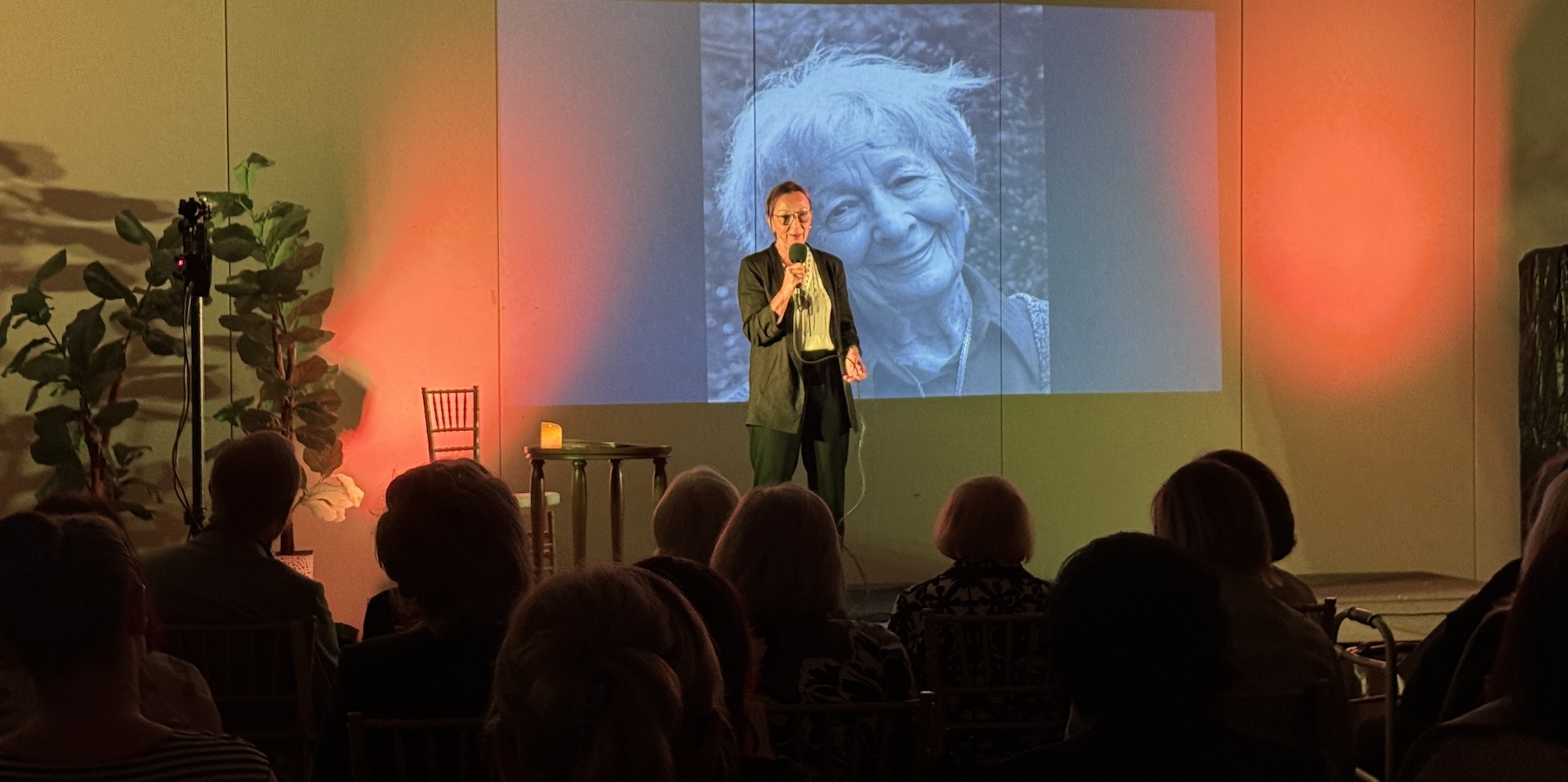
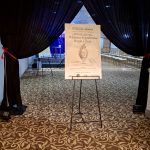
On any other day the APCC’s Hall Number 3 is just a hall, but last Sunday afternoon the room was transformed into an enchanting theatrical venue, complete with black curtains draped at the entrance, a stage, and very atmospheric lighting provided by colorful spotlights and candles.
This theatrical illusion was conjured up by the multi-talented Iwona Jędrzejczak, whose idea it was to bring the Toronto-based Poetry, Music and Theatre Salon once again to a Metropolitan Detroit audience and who tirelessly worked for months to make it happen.
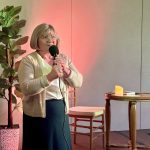

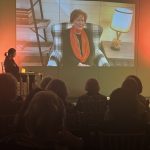
About 70 people came to the hall to enjoy the play “Wisława Szymborska: Poetry and Life”. It was performed by two well-known and much-loved actresses, Maria Nowotarska and Agata Pilitowska, who are the backbone of the theatre which just celebrated its 35th season. The mother and daughter artistic duo have brought their exquisite art to the Detroit area a few times before with fascinating plays about famous Polish women, most recently about Pola Negri and Tamara de Łempicka. Last Sunday’s production was created as a celebration of the author on the 100th anniversary of her birth (Szymborska was born in 1923, and died in 2012) and was brought to us on the 30th anniversary of her receiving the Nobel Prize in Literature.
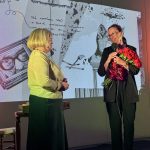
This time Maria Nowotarska was present in Troy only virtually, narrating the life of the famous poetess from the screen, while her daughter Agata Pilitowska was on the stage reciting and reading the poems, and on occasion even dancing and singing. The audience was spellbound by the beauty and power of the poetry, as well as by the marvelous performance. The story of Wisława Szymborska was punctuated by songs sung by the poet’s favorite singer, Ella Fitzgerald, while a poetic tribute to the singer – “Ella in Heaven” – was also included in the selection of poems.
Those familiar with Wisława Szymborska’s poetry know that her poetic oeuvre is rather small: all-in-all approximately 350 poems. But each one of them chiseled to perfection. When asked why no more, Szymborska famously responded “I do have a waste basket”. Stanisław Barańczak, the best translator of Szymborska’s poetry into English wrote the following about her in the New York Times’ article “The Reluctant Poet“ published immediately after she was awarded the1996 Nobel Prize in Literature: “Wit, wisdom and warmth are equally important ingredients in the mixture of qualities that makes her so unusual and every poem of hers so unforgettable. We love her poetry because we instinctively feel that its author genuinely (though by no means uncritically) loves us.”
Among the poems we heard last Sunday were such iconic poems as “Nothing Happens Twice” “Cat in an Empty Apartment” and “The Century’s Decline”.
Maria Nowotarska sprinkled the life story of Wisława Szymborska with amusing anecdotes which showed the great Nobel Prize laureate as a fascinating, somewhat eccentric, down-to-earth person, who sent her friends greeting cards with surreal collages, loved boxing and kitsch, and could not live without cigarettes. This was the reason Szymborska gave to explain why, although she received many invitations to come, she never travelled to the US: she would not be able to spend so many hours on a plane without a smoke. The Nobel Prize, which she receive at the age of 73, and which at first she thought too burdensome, as so many obligations and expectations came with the fame, gave her opportunities to fulfill her youthful dreams to travel internationally, and among other things to establish a foundation which now supports young poets.
Szymborska published her first volume of poetry in 1949 and the last one in 2009, three years before her death. Her poems were undoubtedly inspired by the times she lived in, as well as by personal relations, including those with two outstanding literary men, Adam Włodek, her first husband, and Kornel Filipowicz, her partner for 23 years, and the love of her life.
The best known of these poems is “Cat in Empty Apartment” written after the death of Kornel Filipowicz in 1990. The poem, written from the cat’s perspective, describes the behavior of a cat waiting for its owner who will not be coming back, but the cat does not know it. The poem conveys how utterly incomprehensible death is to us humans.
Szymborska’s poetry is considered quite accessible, but its simplicity is usually deceptive. Referred to as “the Mozart of poetry” and praised for her “stylistic variety” and “a striking combination of esprit, inventiveness and empathy”, Szymborska often uses irony, but is never cynical. Many of her poems express disappointment with the world. In “The Century’s Decline” for instance, she laments the inability of one generation after another to create a world without war or hunger, and where a person cannot be “good” and “strong” at the same time.
The poet is also known for finding the unusual and fascinating in nature which we find common or take for granted, and for showing us – for instance – how extraordinary the fact that we are alive here and now, and that we are in a human, not a different life form, truly is. In the poem “Astonishment” she muses: “Why this specific self, not in the nest, but a house? Sewn up not in scales, but skin? Why on earth now?”
Szymborska reminds us that life is a precious gift, a gift which we did nothing to receive, but which also carries certain moral and ethical obligations. One of them is a constant self-doubt which leads to asking “naïve questions” as Szymborska calls them. Many of her poems are built around such questions.
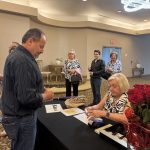
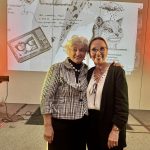
When the performance was over Agata Pilitowska expressed her happiness with the turnout, thanked the organizers and graciously posed for photos. The actor talked to many of the patrons who stayed for coffee, wine and sweets. Ms. Jędrzejczak – following in Szymborska’s footsteps – surprised the audience with a “mini raffle” (“loteryjka”): some of the lucky guests received a packet of an instant Polish-style jelly (“kisiel”) while everyone was encouraged to serve at dinner parties instant soup as Szymborska did.
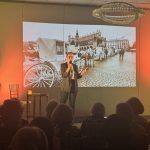

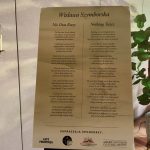
However, this was not an event for people who did not know Polish. Even though most of the poems presented by Agata Pilitowska were available in their English translations in a booklet handed out to attendees, the story of Szymborska’s life, as well as some additional poems, were not translated into English, rendering this part of the performance incomprehensible to non-Polish speakers. It did not bother one of the guests, Frank Dmuchowski, who despite not being able to understand this part of the performance, still enjoyed it a lot.
This begs the question: shouldn’t similar performances in the future – and one with poetry by Maria Jasnorzewska-Pawlikowska was already tentatively discussed – be presented with English translation of the entire performance and in this way be more “user-friendly” to non-Polish speakers?
Last Sunday’s very successful event proved that there is an audience of Polish-speaking people large enough to fill a sizable venue, which is great news. It does not mean, however, that ticket sales would be enough to pay for such an event; high-brow culture has to have its sponsors, that’s how it is everywhere in the world. However, making the play “user-friendly” for non-Polish speakers, of course without compromising the artistic integrity of the performance, could widen the reach of the play and expose more people to Polish culture, like Polish films with English subtitles do.
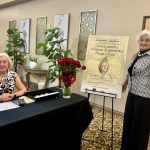
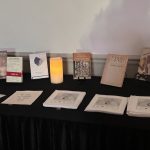
Chapeau bas to Iwona Jędrzejczak, whose commitment and love for the arts was clearly on display last Sunday and visible in all of the personal touches, from the display of books and gorgeous red roses (presented by Brian Malski to Ms. Pilitowska), to mini cheesecakes personally baked by Iwona herself. Working with dedication and enthusiasm, Ms. Jędrzejczak was able to acquire sponsorship of three local organizations – the American Polish Cultural Society, the Polish-American Federal Credit Union and Friends of Polish Art – for this beautiful and moving live theatrical performance. Our thanks and gratitude go to all of them.
We do hope this was but the opening of a new theatrical season in our corner of Michigan.
Sources used:
https://www.nytimes.com/1996/10/27/books/the-reluctant-poet.html
https://www.nobelprize.org/prizes/literature/1996/ceremony-speech/