(An earlier version of this article was published in Polish.)
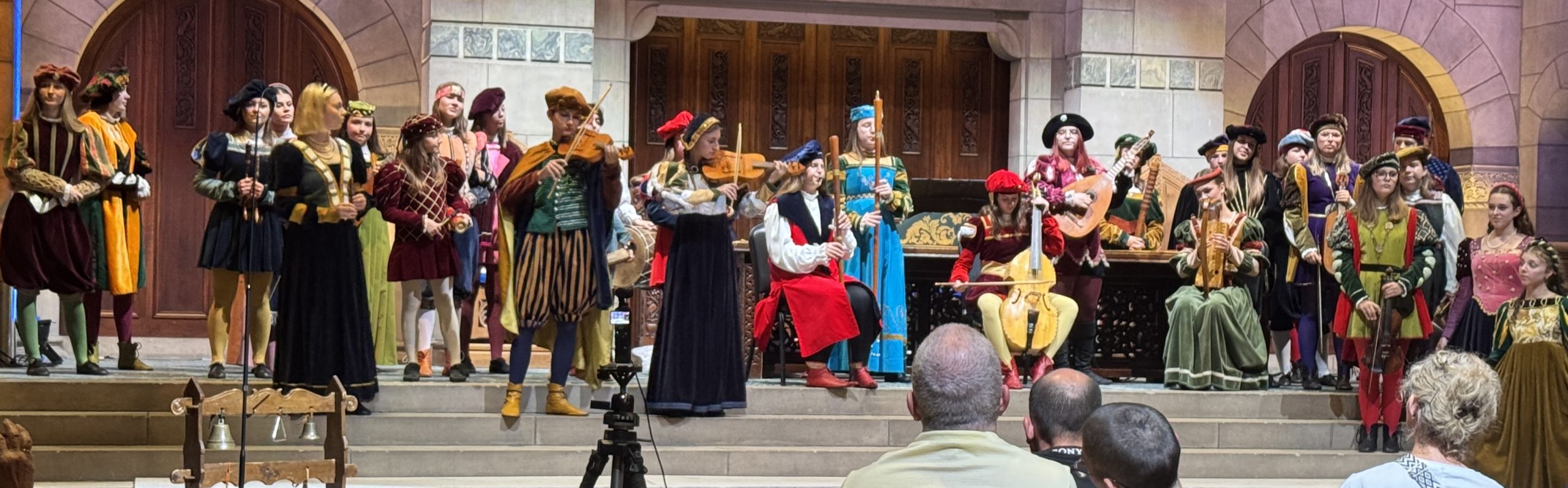
The farewell concert of the Scholares Minores pro Musica Antiqua, the Polish children’s and youth early music ensemble, took place on July 22nd at the monumental neo-Romanesque Fountain Street Church in Grand Rapids.
The Grand Rapids audience, as before them the audiences in Orchard Lake, Dearborn, Detroit, Ann Arbor, Bay City, Boyne City, Elk Rapids, Traverse City, and Holland rewarded the outstanding performers and their teachers, Anna Karwat, Joanna Szafran-Biały, and Justyna Wójcikowska, with thunderous applause and cheers. Having come to see a children’s and youth group they might not have expected such a high level of artistic excellence. (The entire last concert can be viewed on YouTube: https://www.youtube.com/watch?v=GBK65PAnGyU)
The Michigan tour of the critically-acclaimed and well-travelled ensemble was jammed packed. The group has been performing Renaissance and Baroque music for five decades and has previously visited Canada, Australia, Japan, USA and almost all of the European countries. During two weeks (July 9-23) in Michigan the young artists gave 11 concerts and stayed at seven different locations; on one occasion they even per formed twice in one day.
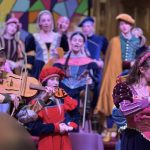
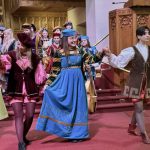
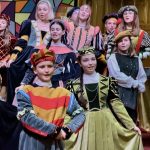
The Grand Rapids concert featured works by such composers as Mikołaj Gomółka, Josquin Despres, Nicolas of Kraków, Orlando di Lasso and Henry Purcell. Scholares Minores sang in Latin, Italian, Polish, and English, played period instruments that had fallen out of common use by the 18th century (such as the knee fiddle, shawm, krummhorn, and hurdy-gurdy), and danced courtly and town folk dances. Their historical choreography, based on authentic records, was specially created for the ensemble by Dariusz Brojek, the “court ballet master” of Cracovia Danza, a professional court and historical dance ensemble. Like Mr. Brojek, the Scholares Minores teachers are very accomplished artists in their own right.
Each of their Michigan concerts, including the one in Grand Rapids, ended with two songs: “Góralu czy ci nie żal” (Highlanders, will you miss your home) and “America the Beautiful”. The sentimental Polish song from the second half of the 19th century about a highlander who had to abandon his beloved mountains “for bread”, has a very special place in many immigrant’s hearts. This time, Anna Karwat, the group director dedicated it to Julia Colingsworth, who had invited the group to tour our state.
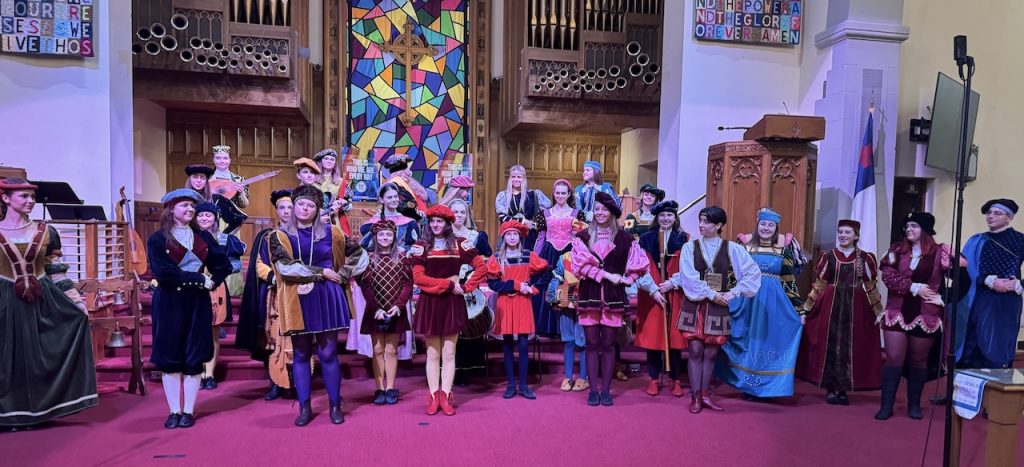 Scholares Minores at Dearborn First United Methodist Church
Julia Colingsworth, the 86-year-old organist and choir director of the Methodist Church in Holland, not only invited the Scholares Minores pro Musica Antiqua but also worked tirelessly for over a year to arrange their concert tour.
Finding concert venues and families willing to host the young artists and their teachers on occasion proved to be quite a challenge, as the group numbered 37 people, 33 of them performers. Yet, there were enough volunteers who supported Julia’s “outlandish” idea, because, like her, they strongly believe in the importance of international cultural exchange. For Polish organizations and parishes, which supported the tour, additional motivation was undoubtedly the fact that the group represented Poland.
How did Ms. Colingsworth, who has no Polish roots, decide to invite this particular ensemble from Poland and undertake the herculean task of organizing their concert tour and stay?
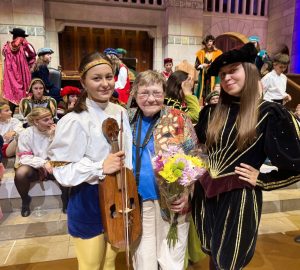 Julia Colingsworth with Julia Gajec and her sister Amelia
It all began about four years ago with another Julia, Julia Gajec, at the time, a senior in a Lublin high school, who qualified for the Greenheart Exchange program. It’s important to know that Julia Colingsworth had hosted international exchange students through this program many times before. This time, due to their shared love of music, she chose Julia Gajec, a member of the Scholares Minores pro Musica Antiqua.Two years later, while in Italy for a Greenheart Exchange conference, Julia Colingsworth, at the invitation of her former house guest, extended her travels to Poland. During the few days which she spent in Poniatowa near Lublin, where the Scholares Minores group is based, she was very impressed by what she saw during the ensemble’s rehearsals: children and youth playing replicas of old instruments, singing Renaissance and Baroque pieces, and performing dances from those periods, all at a very high, professional, artistic level. Ms. Colingsworth also met their excellent, creative and enthusiastic teachers, thanks to whom the ensemble achieved this measure of domestic and international success. It was then that Ms. Colingsworth invited the group to Michigan. She experienced a Scholares concert this year, on July 10th, in the Galeria on the Orchard Lake Schools campus.
Scholares Minores pro Musica Antiqua are the talented children and young people selected during annual auditions from the members of the “Szczygiełki” children’s choir. “Szczygiełki” which numbers approximately 200 children (and five choral groups), was founded in 1975 by Danuta and Witold Danielewicz, great enthusiasts and educators of early music, whom Ms. Colingsworth had the opportunity to meet in Poniatowa.
In July 2025, the “Szczygiełki” choir celebrated its golden anniversary with pomp and circumstance. In attendance were its founders, the Danielewiczs, and many former members of the choir who came to Poniatowa, sometimes from afar. Sadly, Ms. Danuta passed away two months later.
Currently, 13 teachers work with children at the Danuta and Witold Danielewicz After-School Center, which has been directed by Anna Karwat since 2023. All but one of them performed previously with the “Szczygiełki”. During the Michigan tour we had the pleasure of meeting three of them.
Scholares Minores’s Michigan tour was their 128th international tour. Over the years the ensemble has become a significant ambassador of Polish culture and has made the small town of Poniatowa known to music lovers across Europe. Their previous tour, to France, took place in May of this year.Every member of the ensemble sings, plays instruments, and dances, and Saturday rehearsals often last all day.
The lion’s share of the group that performed in Michigan were girls and young women (ages 10–26). I asked Maciej Stachyra, a former member of the ensemble who this time served as photographer and one of the chaperones, why the group is predominantly female. According to him, boys aren’t eager to perform because they don’t like…wearing tights!
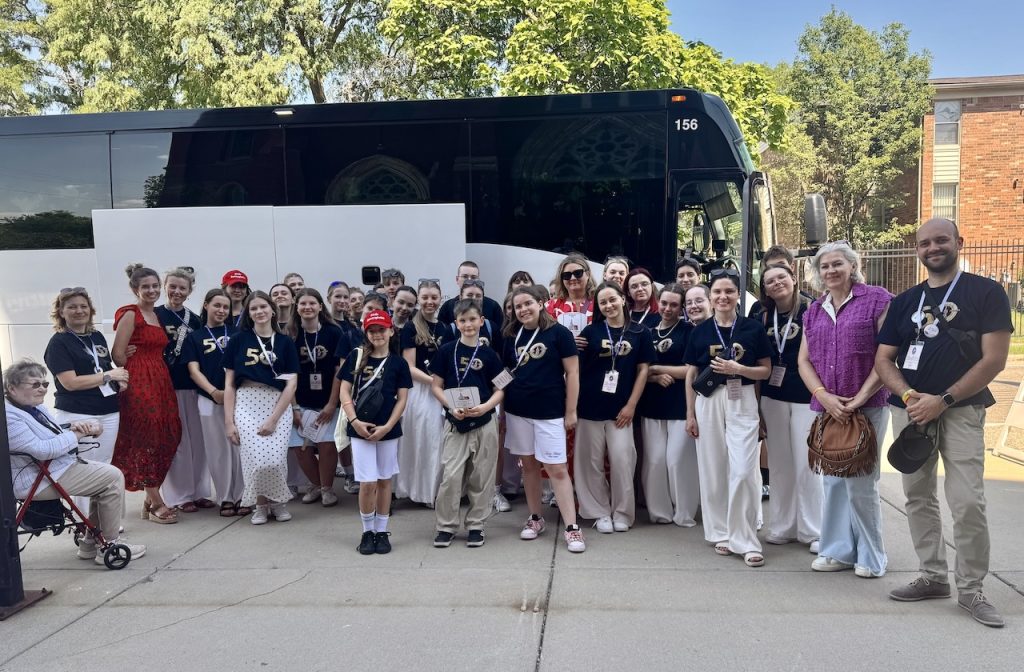 Scholares Minores after their concert at St. Adalbert’s Church in Detroit, with Julia Colingsworth, Ania Bieciuk, Edyta Zydorek, and Agnieszka Wójcik, who traveled from Texas to attend Scholares Minores’ performances.
Edyta Zydorek is from Poniatowa and was a member of the group for many years.
If Ms. Colingsworth had known, back then in Poniatowa, what she was getting into, she might not have invited the group. But fortunately for all of us, captivated by the talent, hard work, and exceptional skills of the group and their teachers, she set her mind on bringing the Scholares Minores to Michigan.
In Michigan Ms. Colingsworth first tried to get institutions professionally involved in promoting culture, such as the Michigan Arts and Culture Council and the Blue Lake Fine Arts Camp, interested in the group, but to no avail. Similarly, the Interlochen Center for the Arts, a venue Ms. Colingsworth believed would be ideal for a concert, was also uninterested in the Polish group.
Undeterred by these setbacks, Ms. Colingsworth, a seasoned volunteer who works with Make-A-Wish, among other organizations, then approached Polish American organizations and religious communities such as Catholic and Methodist parishes, with requests to provide venues for the concerts and host the group. (You can read more about Julia in the article: https://thelakeshorewm.com/cultural-exchange-changed-my-life-why-im-bringing-a-polish-choir-to-michigan/)
And she hit the mark. Although not all of them responded positively, enough volunteered to make the visit possible. In the order in which they hosted the Scholares Minores pro Musica Antiqua, they were: Orchard Lake Schools, headed by Anna Bieciuk, Director of Polonia Affairs at the Polish Institute of Science and Culture (PICROL), who took great care of the group for the first three days; the Polish Cultural Fund-Ann Arbor with Amy Olszewski and Andrzej Dolata, who organized such activities for the ensemble as kayaking on the Huron River and a visit to the Stearns Collection of Musical Instruments at the University of Michigan; Bay City with Deacon Stanley Kuczynski, St. Stanislaus Kostka Parish, and the Tri-City Polish Heritage Society, which accommodated the group in a hotel and invited them on a boat cruise on the bay; St. Matthew’s Parish and Church in Boyne City with Patty Furtaw and Anne Simms, who, among others, prepared box lunches for the ensemble before their departure for St. Ignace; Sacred Heart of Jesus Parish in Elk Rapids with Wes Moulton; St. Joseph’s Parish in Traverse City with David Freundl and Eric Mulvany; and Holland First United Methodist Church, Julia Colingsworth’s home church, where Julia began her campaign. Three churches, the aforementioned Fountain Street Church in Grand Rapids (with Dr. Emmanuel De Leon Jr.), Dearborn First United Methodist Church (with Bob Barnhart), and the historic St. Adalbert Church in Detroit (with Celeste Grabowski), also hosted concerts for the group, while members of the Polish American Historic Site Association, the organization that has been in charge of St. Adalbert Church since 1991, invited Scholares Minores to a Sunday Mass as well as to a picnic celebrating the 154th anniversary of the founding of this first Polish parish in Detroit.
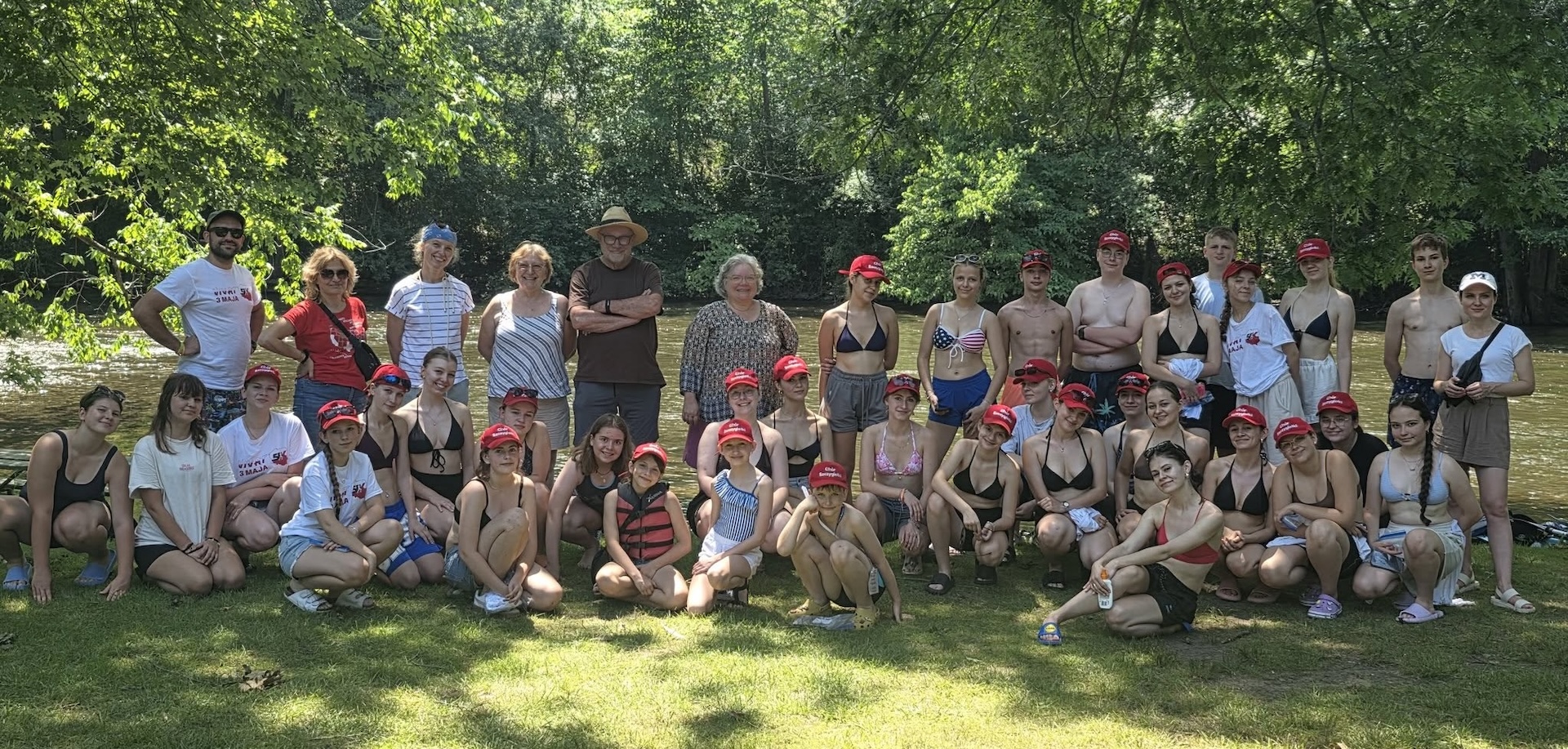 Scholares Minores with their Ann Arbor hosts, led by Amy Olszewski and Andrzej Dolata
All of them (and other individuals too numerous to name here) joined the project with great dedication and enthusiasm, hosted the young artists and ensured they had a wonderful time in Michigan.The parishes cooked meals, the numerous families provided housing, breakfasts, and often additional activities, as well as picked the young artists up and dropped them off at the meeting points. Although it was sometimes difficult to convince parishioners or members of the organization to undertake such a demanding task, those who did, often later said tearful goodbyes to their students, having a hard time parting with them.
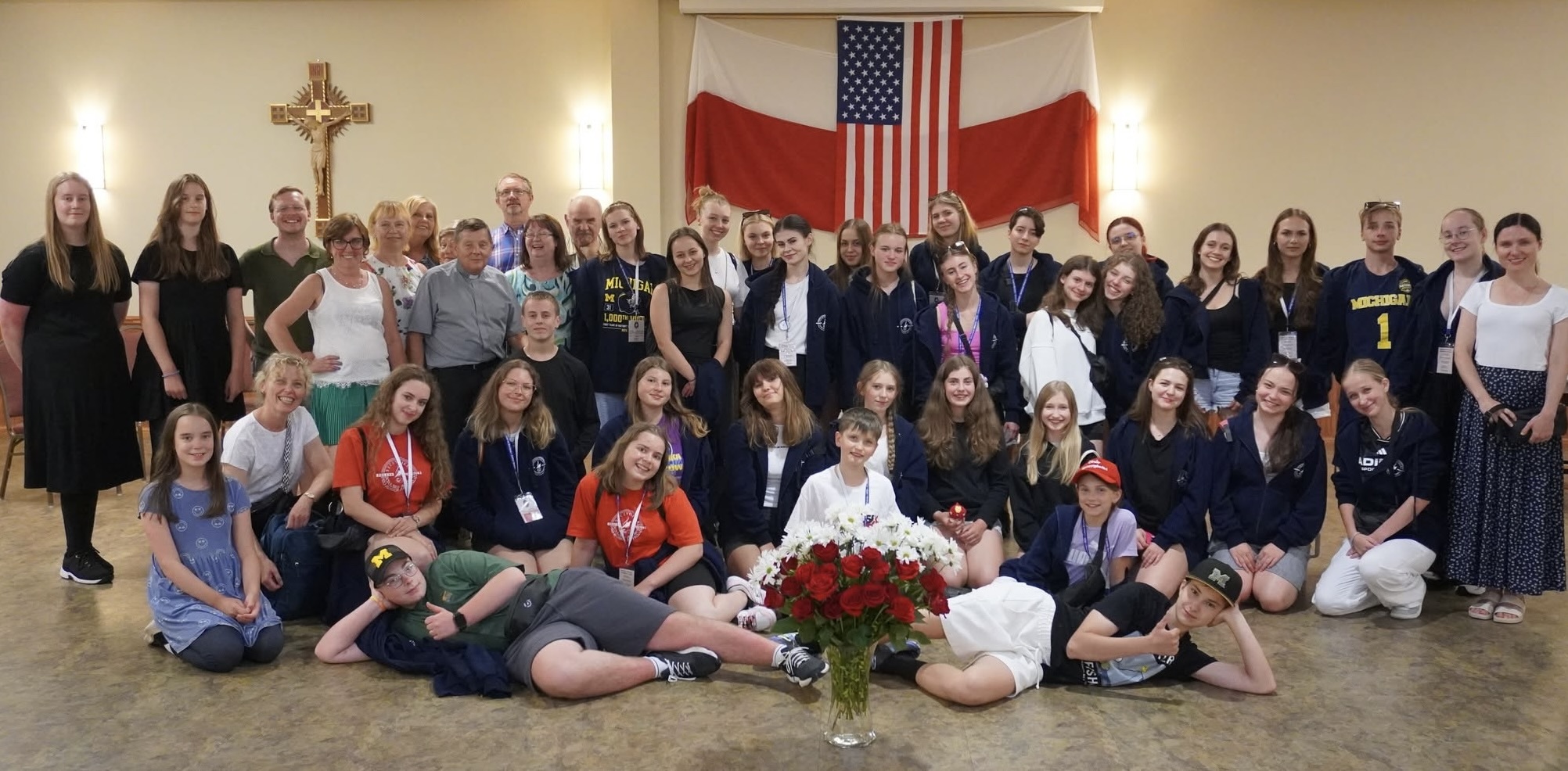 Scholares Minores with their Bay City hosts, led by Deacon Stanley Kuczynski
The young artists, as well as their teachers, are not only exceptionally talented but also incredibly kind people: warm, humble, communicative, and very grateful for such hearty hospitality.
A separate aspect of organizing the tour was renting a bus to allow the ensemble to travel around Michigan. The cost was expected to exceed $20,000, and this had to be cash, not in-kind donations. Because the group was carrying crates of instruments and costumes, it had to be a large bus.
And here the Friends of Polish Art (FPA) stepped in to help, not only being the first to pledge financial support but also organizing a fundraiser for the cause. The Polish American Federal Credit Union (which also generously supported the group’s stay in Orchard Lake and Ann Arbor) and the Polish American Congress-Michigan Chapter immediately responded to the FPA’s appeal. The fundraiser, coordinated by the FPA, was later joined by Club Polonia of Wyandotte, the Polish National Alliance-Council 122, the Filarets Choir, Krystyna’s European Spa, the Suzanne Sloat and Ray Okonski Foundation, the Polish Day Parade, the PRCUA dance groups “Halka,” “Zakopane,” and “Zajączek”, the American Polish Cultural Society, the Wessels & Wilk Funeral Home, and many FPA members.
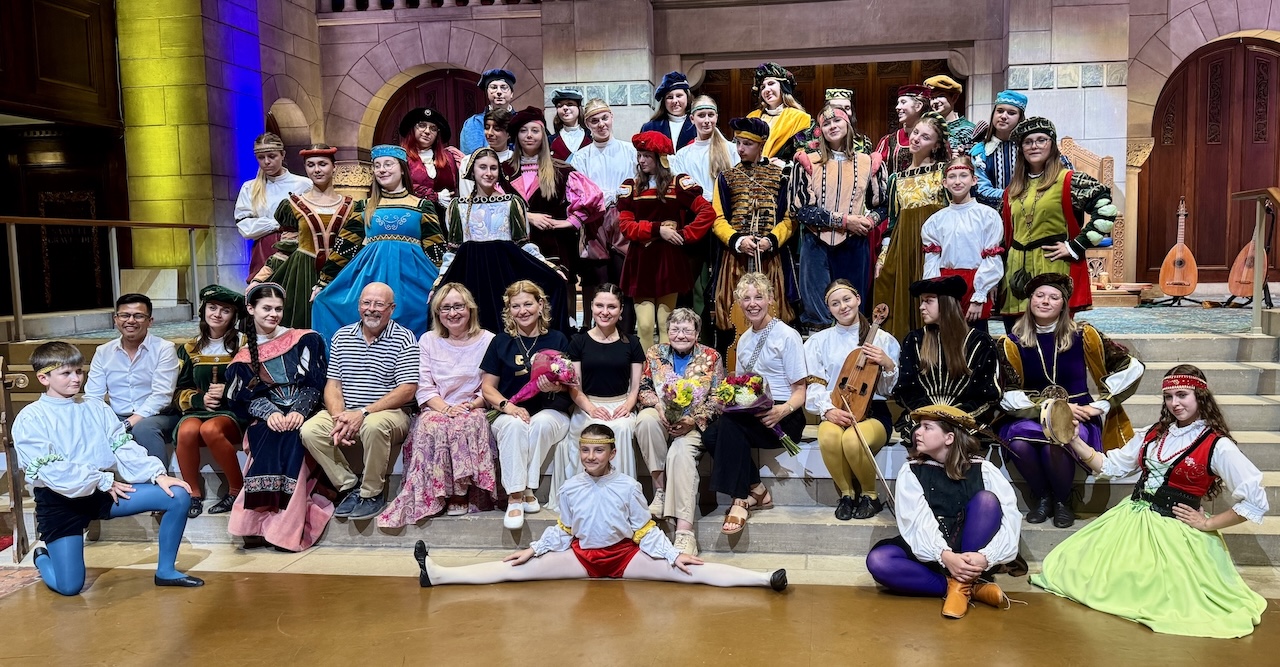 Fountain Street Church in Grand Rapids: Scholares Minores pro Musica Antiqua with Anna Karwat, Joanna Szafran-Biały, Justyna Wójcikowska, Julia Colingsworth, Dr. Emmanuel De Leon Jr.,
Brian Malski (FPA), and Alina Klin (FPA)
An additional source of needed funds was a GoFundMe campaign set up by Julia Colingsworth. The funds raised covered part of the bus (or rather: buses, as to keep the cost down, two bus companies were involved) rental costs as well as paid for a hotel in Paradise in the Upper Peninsula and ferry tickets to Mackinaw Island.
Unfortunately, during the days the group visited the island and Tahquamenon Falls in the Upper Peninsula, the air in this part of Michigan was heavily polluted with smoke and dust which had drifted in from Canada, where drought-related forest fires were raging. In Bay City, clouds obscured the sun, so before leaving, the hosts arranged for masks, which the group wore to visit Hartwick Pines Park. This wasn’t the only park on the tour: Julia Colingsworth ensured that the visitors had contact with the beautiful nature for which our state is famous, as well as learned about its culture and history (Greenfield Village in Dearborn and the Grand Rapids Public Museum, which houses a permanent exhibition dedicated to Polish-American cultural heritage, among other places, were included in the program).
We said goodbye to Scholares Minores pro Musica Antiqua on Thursday, July 23. With confidence we can state that their Michigan tour was a great success.
It’s time for a couple of more general reflections.
First of all, let’s ask ourselves how something like this—11 performances by a large group of artists from Poland—could be organized differently. Let’s be honest, Julia’s idea, which relied entirely on her own work and the goodwill of volunteers, was met with a complete lack of understanding, even criticism, from some members of the Polish American community.I’ll leave the answer to that question for the critics. One thing is certain: any other way of organizing such a tour would have required the prior accumulation of VERY substantial funds, which, as we know, is not easy. The airline tickets alone, financed this time primarily by the parents of the young artists, cost approximately $50,000.
 Boyne City hosts are welcoming the Scholares Minores
Let’s therefore be grateful that one amazing person was able to generate enthusiasm for the project and first succeeded in encouraging the group to come, and then in mobilizing an army of volunteers, including numerous Polish American organizations, for what became a very fruitful and immensely satisfying cooperation.
In the context of the 250th anniversary of the founding of the United States, one can see that this fantastic undertaking reflects both American individualism (Ms. Julia) and the beauty of a joint, successful effort.*
Ms. Julia Colingsworth, risking much (also financially), offered us, the Polish Americans, a great opportunity to unite our efforts and together enable a group of young artists to present Polish culture here. Thanks to Ms. Colingsworth (and everyone who supported this project), over two thousand residents of our state had the opportunity to participate in beautiful musical and theatrical performances, gain an exposure to early music, exquisite singing, historical dances and costumes, and discover the sound of archaic instruments. They were able to learn that Polish culture, most often associated with pierogi and folk dance performances, has much more to offer. The artists brought with them beautiful music, but also their youth and contemporary Poland, and they experienced, and will likely always remember, the America we love and admire most: open, multicultural, trusting, and hospitable.
We extend our heartfelt thanks to the incomparable Julia Colingsworth for her efforts, which made the concert tour and the Scholares Minores pro Musica Antiqua’s visit to Michigan such a success! We are also immensely grateful to all the individuals and organizations who made such a significant contribution to this endeavor. We thank and congratulate these brilliant young artists and their wonderful teachers and mentors! We will keep you in our hearts and memories.
Text and photos: Alina Klin
Additional photos: Scholares Minores pro Musica Antiqua FaceBook
*The metaphor that comes to mind here is barn raising. As we know, the wooden structure of a barn is first built on the ground, and then its elements are erected vertically by a large group of neighbors enlisted to help. The tradition of providing free and selfless assistance to a neighbor who would otherwise be unable to do the work is still being cultivated, dating back to the 18th century, and speaks volumes about the United States, often perceived as an extremely individualistic country. Our “barn,” built through joint effort, was the two-week tour and stay of the Scholares Minores pro Musica Antiqua group in Michigan.