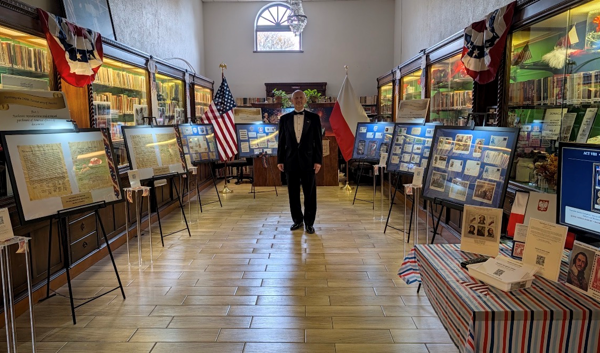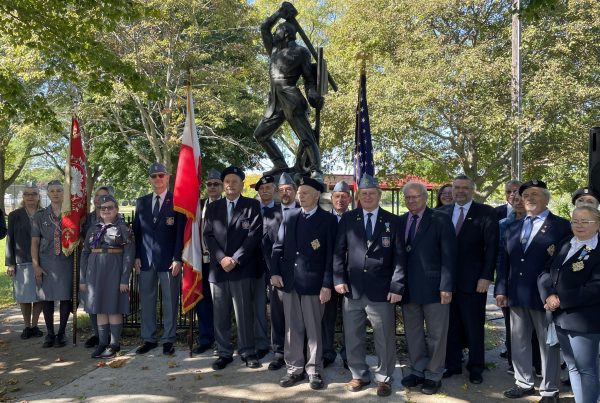
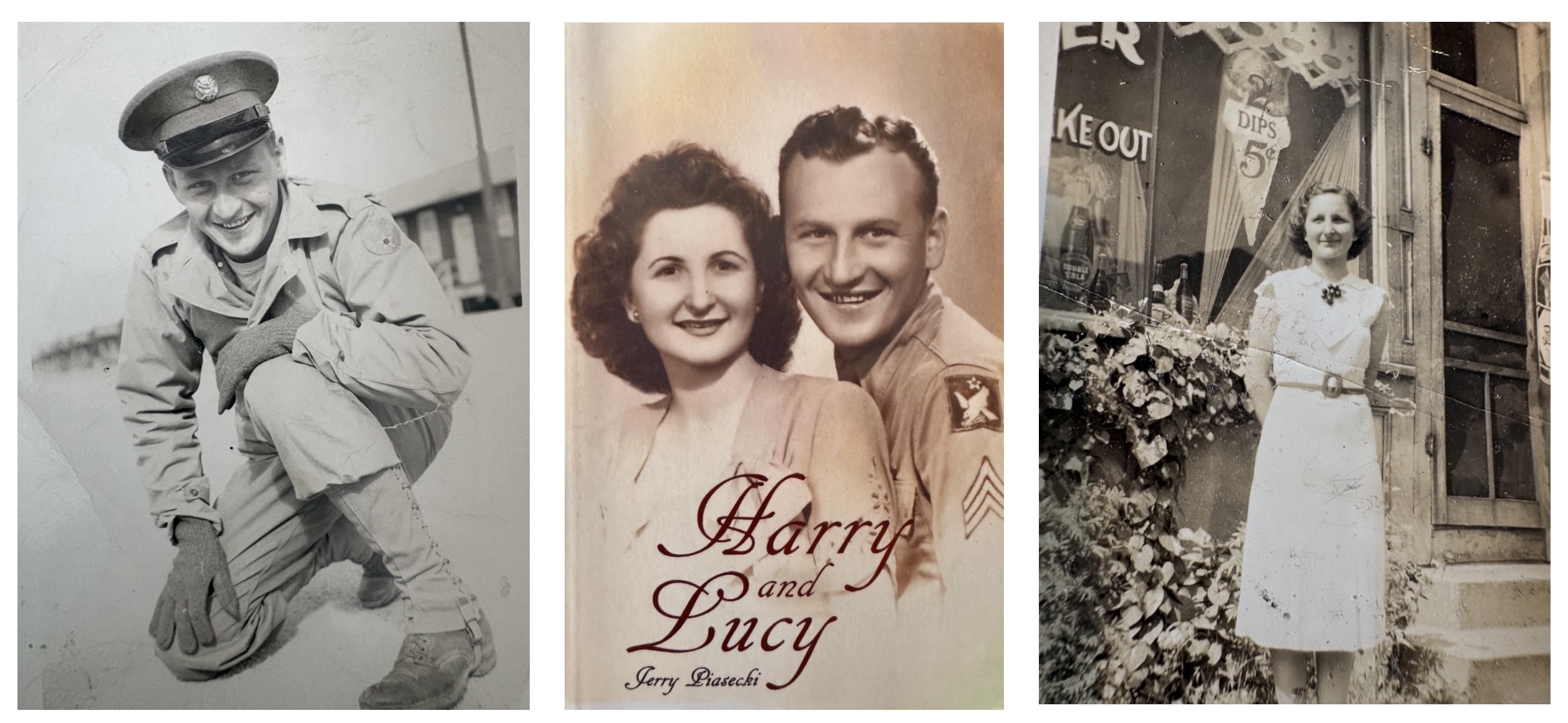
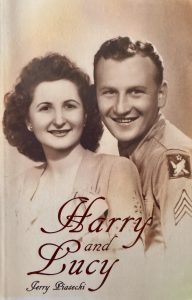
Jerry Piasecki was born in 1950 in predominantly Polish Northeast Detroit. He is the author of the novel Harry and Lucy which he describes as “a historical/mystical love story which traces the real-life love saga of the title characters from a candy store in Hamtramck Michigan during the Great Depression, through WWII and beyond. It is the story of an angel and her hero in this life and beyond.”
Mr. Piasecki resides in Connecticut and Michigan.
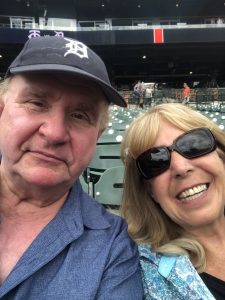
Jerry Piasecki with his wife Wendy Rollin.
Alina Klin: Thank you so much for agreeing to this interview.
Before we talk about your book Harry and Lucy, let’s talk about you. From a short bio included in the book and from your LinkedIn profile I learned that prior to writing Harry and Lucy (published in 2019) you wrote 13 young readers novels, had a very successful career in broadcast journalism – internationally as well as in Detroit and New York – and spent 18 years with the United Nations, where among others, you created the United Nations Global Peace School Program, and developed and led the United Nations Radio News Service. You have also been mentoring young authors in partnership with Global Communities for Peace and the Muhammad Ali Center in such countries as Australia, Nepal and the United States. In addition, you worked as a creative director of an advertising marketing agency. You are involved, among others, in such causes as civil rights and social action, children, economic development, empowerment, education, environment, health, human rights, disaster, and humanitarian relief, and that’s not the entire list. You are an author, consultant, journalist, educator, editor, and activist.
If this is not an awe-inspiring resume and not mentioning a life, I don’t know what is …
Jerry Piasecki: (chuckles) Well, thank you. It’s been busy…
AK: Which of these hats – of the author, consultant, journalist, educator, editor or activist – suits you the best?
Jerry Piasecki: All of them… Things are such a combination. Author would probably be the most suitable because it truly combines many of the other things into one.
AK: You grew up in Hamtramck, attended Cass Tech and graduated in 1972 from Wayne State University with a BA in mass communication. Was your first job as a journalist in Detroit?
Jerry Piasecki: Well, actually, much of my family were from Hamtramck and lived in Hamtramck, but my parents moved to Northeast Detroit, just outside of Hamtramck. So I was born and raised close to the border, not actually in Hamtramck although I spent an enormous amount of time with family there. My memories of growing up in Hamtramck, but living in Northeast Detroit, go back to St. Florian, to the Little League baseball team that in 1959 won the World Series, to shopping with my mother at Federals on Joseph Campau… My roots are certainly in Hamtramck… And in Poland, of course.
AK: Do you remember Hamtramck as being mostly Polish?
Jerry Piasecki: Never only, but I do think that for a long period of time, the Polish population was extremely relevant and large there. When I was growing up, street signs were in Polish, the storefronts’ names were in Polish. The church mass in Saint Florian was in Polish. So, certainly, the culture within the community was predominantly Polish. At least what I saw, because I’m predominantly Polish, actually all Polish.
AK: Did you and your family keep within their ethnic group?
Jerry Piasecki: Yes, pretty much. The neighborhood in Northeast Detroit was all Polish except for perhaps 2 or 3 people… My neighbors, Pani Zosia and Mr. Mike, came directly from Poland; loved them very much.
AK: Now going back to your first job as a journalist. Was the job in Detroit? And what did you do?
Jerry Piasecki: My first job as a journalist was at the WDET Public Radio in Detroit. That was when I was still a student at Wayne State University.
AK: I listen to WDET a lot. What did you do there?
Jerry Piasecki: I was a newscaster.
AK: Did you write your own reports or did you just read what was written for you?
Jerry Piasecki: Oh, no, this is something that goes directly to my old school journalism, where I would always insist at whatever station I was at, that everything needed to be rewritten for each single newscast, and it was not just “rip-and-read” from the Associated Press or United Press International. Writing and storytelling on radio, I think, is the most important part of radio journalism, because you have to create a picture with your words. You have to tell a story. You have to take people to the place just with your words. And I feel that the most incredible part of journalism, is the writing.
AK: Did you cover local stories when you worked at WDET as a student?
Jerry Piasecki: Yes, I did both local and national stories, and did a lot of street reporting, and going out on the street and reporting was my major love in journalism. That was at the time when a lot of demonstrations were held in colleges. I remember going out to anti-war demonstrations with a Wollensak tape recorder, it was reel-to-reel back then, old reel-to-reel tape recorders is what we started with. Wayne State University was a wonderful place to learn journalism.
AK: Where did you go from Wayne State?
Jerry Piasecki: Radio is one of those things where you go from one station to another – hopefully to a larger one. After WDET, I moved to a station in suburban New York, in White Plains, New York. My sister, Carole Piasecki, had moved to New York to be an actress – and actually she made it into a couple of Broadway shows – and she lived out there, so I became familiar with the area. While visiting her, I stopped by this radio station in White Plains and got a job there. And from there, I moved back to Detroit, worked at a music station, did news there for quite a while and then moved back to New York for another job, and it was back and forth, and back and forth…
AK: When you were at WDET, did you do any stories about the Polish community?
Jerry Piasecki: I tried to. I did stories on Hamtramck; covered the city council to the degree time permitted. And in fact, one of my favorite journalistic accomplishments, if you can say that, of all of the things that I’ve done – of traveling the world and doing this, and going to this story and that story – so one of my favorite things that I ever done, was a story I did based on Northeast Detroit, where they wanted to change how the garbage was being collected. They wanted people to have to roll their garbage cans out to the street. Well, the senior citizens in my neighborhood couldn’t do that. And I was able to do a story. The publicity got that changed back to something that they could do, and I’m very proud of that. That’s one of my favorite memories.
AK: That’s a wonderful memory. You must have been 20 or 21 at the time.
Jerry Piasecki: Right.
AK: And you made a difference. That’s such an empowering experience.
Jerry Piasecki: Yes, that one made a difference. But so many stories don’t – you’re there just to inform people, that’s okay, and then that’s the difference that you make. But this one actually resulted in a physical benefit to the Polish people of my neighborhood.
AK: How did you get involved with the United Nations? Could you talk a little bit about your work there?
Jerry Piasecki: The United Nations was certainly an amazing experience. Truly all of my work prepared me for what I did in the book Harry and Lucy, but the United Nations more than anything. When I moved back to New York I had a friend who worked at the United Nations in what was called – are you ready for this? – The Office for the Coordination of Humanitarian Affairs. Shortened to OCHA. She had an opening in her department so then I went to work with her. We quickly decided that what I could do is write. So then I started writing books on the lives of children in areas of conflict and war.
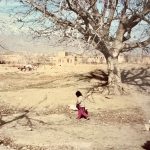

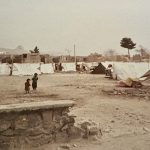
Left to right: Children looking for firewood in mine field, a village in the DRC and a refugee camp in Afganistan.
In that capacity, I was fortunate enough and truly grateful to have the opportunity to travel to places where most people don’t go, and meet with people and get to know people, particularly children, who are caught in the horrors of conflicts. To places like the eastern part of the Democratic Republic of Congo, Rwanda, Uganda, Afghanistan, the Pakistani border, Bosnia, Sarajevo … Places where you really get to know people and you see both the worst part of humanity and the most noble, the most heroic part of what human beings are capable of. And what you realize is that each one of them has a story, a story that needs to be told and should be told. Wherever I’ve traveled, all of them want one thing more than anything else in the world, and it is to be recognized. And to have respect. I was very fortunate with the United Nations to do that with OCHA. Then I transferred to an even longer-titled organization within the UN called the Office of the Special Representative of the Secretary General for Children in Armed Conflict.
AK: A very long name indeed…
Jerry Piasecki: I was able to go to a lot of different places, and tell the stories of these people and write the first novels ever published by the United Nations.
AK: Amazing! Please tell us more about these novels.
Jerry Piasecki: They were fact-based novels. In other words, all of the events in the novels really happened. Now, I took all of those events and put them into stories. So I guess you would call them fiction, but they were fact-based fiction.
AK: Very interesting. You were at the UN for a total of about 18 years. That’s a long time.

Jerry Piasecki in Studio 5 of UN Radio, 2005
Jerry Piasecki: At least half of that time I was writing the books; the rest of it I was working with the United Nations radio, establishing the United Nations Radio News Service, which was a radio programming, designed to reach the American market. Interestingly, at that time they had divisions within UN radio to reach other markets, like a Russian unit, a Spanish unit, a Portuguese unit or a Chinese unit, but they had no radio that reached specifically the United States. My job was to create that.
AK: I read that you became the first director of that division and led it for a few years. It is very impressive!
Jerry Piasecki: Thank you!
AK: As our main topic – although we didn’t get much into it yet – is your fiction writing, could we get back to your books published by the UN. I understand that these were very compelling stories of children, coping with extremely difficult situations.
Jerry Piasecki: Yes, and those are the very first novels ever published by the United Nations. The UN would also sell the rights to the books to publishers in different countries. Now, prior to that, I wrote children’ books, but they were just fantasy, fun, humor kind of books. And I had multiple books like that published by traditional publishers in the United States.
AK: Your children’s books were – and are – available in countries like Italy, Portugal, China, and also in Poland.
Jerry Piasecki: Yes, the UN-published books were globally distributed and also translated into a lot of languages. Actually, my earlier humorous books were translated and sold in Poland.
AK: I just checked, and eight of them were published in Polish at the beginning of the 2000s, among them Teacher Vic is a Vampire Retired (Mój nauczyciel jest wampirem, 2002), They’re Torturing Teachers in Room 104 (Nauczycieli torturuje się w sali 104) and Laura for Dessert (Laura na deser). They are still available. I love the titles!
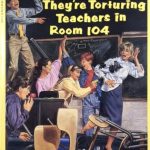

Jerry Piasecki: There were two humor books that featured a retired vampire.
AK: Why did you decide to write for young people in the first place?
Jerry Piasecki: Well, I was inspired by my daughter, Amanda. When she was young, I was a journalist, working in news and radio and I would always tell her stories. I was inspired by her imagination and in turn her imagination sparked my imagination. So I just started making up stories and that led to writing my first book … and it just went from there… I would credit her with being my inspiration for them. Also, I would credit my wife Wendy Rollin for her creative support and encouragement. As I say in the dedication in my first published book; “Without Amanda this novel would not have happened, and without Wendy this novel never could have happened.”
AK: On LinkedIn you introduce yourself as a “peace educator”. Could you unpack this for me? How does one educate peace?
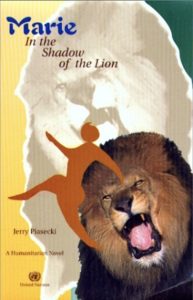
Jerry Piasecki: I did it through my UN novels. We established, in collaboration with the Muhammad Ali Center out of Louisville, Kentucky, what was called the Global Peace School Program, a program where young people, through writing to each other, would relate to other young people all around the world. We would connect schools. For example, we connected the school in a very wealthy area of Connecticut, with an impoverished war-torn area in the Democratic Republic of the Congo. What I loved about that is that the students in Connecticut had photographs of all of the Congolese students on the wall. And the students in Congo had photographs of all of the Connecticut students on the wall. And in so doing, we were able to connect these students in a human way, where they knew each other as human beings, not as adversaries, not as some strange foreigners, but as people. And that’s one way how you educate for peace. Muhammad Ali wrote the forward to Tomas and Deng-Paradise Buring, my second UN – published book – it was extraordinary, as he rarely did this kind of thing. The forward to my first UN book, Marie – In the Shadow of the Lion, was written by Kofi Annan, who served as a Secretary-General of the United Nations.
AK: Fascinating. Are you planning to write more novels for young people?
Jerry Piasecki: We will see where the world takes me, I don’t know …
AK: Let’s talk about Harry and Lucy. It is your first book written for adults. The main character of the book is Jerry Piasecki, which we, the readers, assume, is your alter ego. Then another assumption follows, that the book is autobiographical. Are these assumptions correct?
Jerry Piasecki: To a very large degree, yes. I learned from writing my books about children in war, how to write this book. And that is, I took events that happened and created the story around them. In Harry and Lucy every single thing that happened to Harry and Lucy, in this world: their life in Hamtramck, where my father, Harry had to take coal from the railroad yard to survive, where my mother, Lucy worked at the candy store, where she and Harry met because Harry would bring a penny every day to that store to buy one piece of Beeman’s gum, and to see his angel at the store – as well as every other single story in that book – all of it is absolutely true. It creates and tells their love story. Now, what I have found out is that when you tell somebody’s story, to make it truly real, it is good to incorporate, as much as possible, not only what they did, but also what they believed. Because “belief” to me is often as real, if not more real than what we call “reality”. What I refer to as the “mystical” parts in the book is based on what I know Harry and Lucy believed because they told me so. That they would be together again and forever, and that their love would last forever. So that’s it.
AK: What I hear from you is that to be an effective storyteller, it is important to go beyond just relating the facts.
Jerry Piasecki: Right, because truth and belief, reality and belief, the line between them often blurs.
AK: Why and when did you get the idea to write a book about your parents?
Jerry Piasecki: I had already been working at the United Nations writing the books on children in war, when Lucy, my mom, passed away. And it was after that, that I got the idea for writing this book by going to Petoskey and knowing what she felt, and knowing what she believed. I also have to give full credit to my wife, Wendy Rollin for being an inspiration for this book. She also wrote the theme song to the book.
AK: A theme song? That’s a very interesting idea! (To listen to the song, click on the link)
Jerry Piasecki: Wendy was a huge inspiration to me to complete this project.
AK: How long did it take you? I assume there was research involved too? The trip, like you said, to Petoskey and visiting all of the places you knew from your childhood was a part of it, but what other kind of research did you do?
Jerry Piasecki: I started writing the book in 2008.
AK: So it took you 11 years.
Jerry Piasecki: Right. I did the research, for example, the story about the terrible accident at the railroad crossing which I knew as a child because my parents told me the story. I wanted to authenticate it so I went to the newspapers of the day and quoted the actual reports on the incident, as you know from the book.
AK: Yes, I remember –
Jerry Piasecki: So that was the type of research that I did. I wanted to make sure, for instance, that the names of the streets and of the stores were correct. Yeah, I spent a lot of time driving around Hamtramck, both literally, and via Google roadmap…
AK: It is great to have these modern conveniences…
Jerry Piasecki: I spent a lot of time walking the streets they walked and seeing what they saw. That’s what I felt about writing books on children in war is that you had to go there and you had to breathe the air. You had to feel the ground. You had to eat the food. You had to see the stars they saw. And I felt that way writing Harry and Lucy. Now, Petoskey – I have a long family background of going to Petoskey.
AK: Yes, I know it from reading your book.
Jerry Piasecki: And, there is this story of my father almost buying a business in Petoskey. And of my mother and father, with my sister and me, spending a lot of time there; they both loved Petoskey as well. That’s where I knew they would want to be together.
AK: There is one chapter in your book which consists almost exclusively of letters. I know, from our previous conversation, that all these letters, written by Harry to Lucy, and Lucy to Harry are authentic and they were written in 1944 shortly after they got married. At the time, Harry was in Texas going through military training and awaiting to be shipped out.
Jerry Piasecki: Correct.
AK: How did you come in the possession of them? I assume the letters were preserved by your mother, right? What is the history of these letters?
Jerry Piasecki: My mother used to have an old, green fishing tackle box.
AK:I remember it from the book.
Jerry Piasecki: She put papers in it including my father’s army discharge papers and his driver’s license; things like that. So when I started writing the book, I decided to look through that box. There I found the stack of letters that she kept from World War Two that were letters from her to him and him to her. When I found that, I thought, well, their communications during the war will make an interesting chapter. Other than for certain transitions, I used only their words in the whole chapter.
AK: It’s an amazing chapter. Did you use all of the letters?
Jerry Piasecki: No, not all. Suddenly these letters were telling a story that I did not expect. And never knew about it, and neither did my sister. But these letters, put together, as you know, having read the book…
AK: Twice…
Jerry Piasecki: … end up telling a truth, telling a real story.
AK: Without giving too much away because we want people to read your novel: it’s a very powerful chapter of your book.
Jerry Piasecki: And it’s their words; they are alive in that chapter.
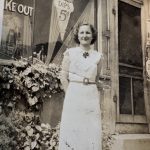
AK: They are young, in love and full of hope.
Jerry Piasecki: Right, and they weren’t worried about writing style or correct grammar.
AK: Harry and Lucy is a Polish American story but also an American story. How do you see it?
Jerry Piasecki: I view it very much as a Polish American story because that’s what it is. I very strongly believe, or I would like to be part of something, that would keep the generation of Polish families, whether they were expats or first generation, that came to Hamtramck, lived in Hamtramck, and created lives in Hamtramck and their stories alive. They deserve to be kept alive, because they’re beautiful, and every single person has a story. So, really, it is a Polish, Polish American story. My father considered himself Polish American; if you asked him, Harry, what are you? He would answer: I’m Polish American. My background is Polish. My name is Polish, and so I would say it is a Polish American story. About Polish people living in America.
AK: Do you consider yourself a Polish American author?
Jerry Piasecki: Yes.
AK: What role, if any, have your ethnicity and upbringing played in your life?
Jerry Piasecki: The values that I was taught played a role in my life. Obviously this is a generalization, because people are different and there’s good and bad in all people, but in my neighborhood I was taught honesty, and I was taught toughness, and again I was taught to be honest.
I try to employ those things in my writing. Like in the books about war. I’m very honest about war there: when somebody dies, they die. When somebody gets killed, they get killed. I don’t write a flowery version of it because that’s not how war is. Suddenly someone’s walking and a bullet comes and kills them. That’s it. It’s over. There’s no “and the bullet tore through the flesh…” No, it’s direct. It’s simple in its horror.
AK: Some people, unfortunately, don’t understand what war brings.
Jerry Piasecki: Well, because they haven’t seen it.
AK: In his letters Harry writes on occasion: I hate being there, I hate being in military, I hate being away from you. Although he’s also very patriotic – he enlists immediately after the US enters the war.
Jerry Piasecki: Oh, yes.
AK: It’s very human, very touching.
Jerry Piasecki: When I worked with my dad at the 7 Mile Hub in Detroit, almost all of the people who came in were workers at Dodge Main, the vast majority of them Polish, and almost all of them were war veterans. They did not sugarcoat what war was because they saw it. They know what it was.
AK: Does this bar still exist?
Jerry Piasecki: No, the last time I drove by, it was all boarded up, but I think it was demolished since.
AK: Detroit is coming back, but perhaps not this area yet.
Jerry Piasecki: Yes. I’m very excited about that.
AK: Me too! Have you ever felt that your ethnicity held you back? Or perhaps the opposite happened and somehow it has helped you in your career. Your father, however, based on the book, did experience some prejudice. I understand there was a considerable amount of it.
Jerry Piasecki: I certainly think that being white in this country, covers a lot of sins.
I mean, you can blend in more readily – and I did. However, when I got my job at WFAS, in White Plains, New York, I had to change my name, because they didn’t want any ethnic names on the air. So I changed it – from “Piasecki” to “Sand”, which in Polish means “piasek”.
AK: And that was okay with you?
Jerry Piasecki: No, but I had to do that. Now, I know that some members of my my parents’ family or grandparents’ family changed their names so that they could succeed better in business, but that wasn’t my situation. I know my mother’s brothers changed their names from “Buraczynski” to “Burns”. And I knew some others that did the same thing for the very reason that they felt discriminated against in the workforce. I never faced it.
AK:. How long had you been “Sand”?
Jerry Piasecki: Oh, that was just for a while when I was at that one radio station. When I went back to Detroit, I could be Jerry Piasecki again.
AK: Do you now feel any emotions about this? Do you – or did you – feel that it was an injustice done to you?
Jerry Piasecki: I truly didn’t, I disliked it very much, but it was how it was at the time. There was a Jewish man at the station who had to change his name, there was an Italian man at the station who also changed his name. However, at that point I also worked as a stringer, as a reporter in Westchester County, for a radio station in New York City which had a large Polish listenership in Queens. So on that station, I would be “Piasecki”.
AK: What is a stringer? I don’t know.
Jerry Piasecki: A stringer is a reporter who works in a location outside of the station. For example, a stringer in Detroit might work in Lansing, or might work in Ann Arbor, and they would give reports only from that particular area.
AK: I see. Being a stringer allowed you to be Piasecki as well. Let me ask you this: Was Harry and Lucy a vanity project?
Jerry Piasecki: No.
AK: A very decisive answer…
Jerry Piasecki: Oh, no, no, no, it wasn’t.
AK: There’s more to it than just immortalizing a part of yourself…
Jerry Piasecki: Much more. The main thing in any writing, in all of my books, or in every story I’ve ever written, was and is, to tell a story, and that’s what I wanted to do.
AK: When I encounter a book, which belongs to the nowadays very popular genre of family histories, I usually don’t expect it to be a good read, to deliver as “literature”. Your book does; it pulls the reader right in, and it happens I think because you chose for it, a particular form, in which there is present time, with two storylines, one of them the road trip, the second one of Jerry’s mother, Lucy, and there is the past brought in by memories, which are mostly triggered by the trip. But there is also this other dimension, which you referred to as “mystical”.
And this was quite unexpected to me. Only when I read the book for the second time and paid very close attention, I noticed how you introduced and developed it. These “mystical” parts of the book, as you said reflect beliefs of people, not their reality. Would it be possible to write this story without including these mystical or supernatural passages?
Jerry Piasecki: Yes, it would, but I don’t think it would be as good of a story or as complete of a story. The belief to me is as real as reality in most cases. They’re all part of one. If you cut one out, it’s cutting the body in half. And you’re not telling the whole story at that point. I wrote two books on an Aboriginal family in Australia. In them I took an Australian family from deep Outback into an urban environment and I showed how their beliefs were challenged. And they existed there as they would be living in the deep Outback environment. That was a very interesting project.
AK: It sounds like it.
Jerry Piasecki: When I went into the Outback, I was in a place that was 4000 miles from anywhere. You wouldn’t even call it rural. You couldn’t, it was just in the middle of nothingness. It was a magical, beautiful place. But when I went there, the people still had their favorite food. They had their favorite color. They had their favorite clothing. They did their hair. They were still people. The same as people in Detroit or anywhere else and that made it very special.
AK: We already talked a bit about the Petosky area. These parts of your book were like love letter written to Up North Michigan or a travel blog encouraging one to follow in the protagonist’s footsteps and explore, for example, the fish hatchery. I, for one, have not seen it yet, but I intend to, once I go to Petosky again. Do you think that people are taking Harry and Lucy with them and go looking for the places you described?
Jerry Piasecki: (laughing) Oh, I hope so! I hope so, because Petoskey is one of my favorite places on earth.
AK: I can tell.
Jerry Piasecki: And I just love it. The fish hatchery – I will highly promote the fish hatchery. When I was little, it was just 3 or 4 concrete bins in the ground and all these fish inside of it. Now, it’s like this whole walking trail park, with bridges and ponds, and you can go underground and look at the fish under the water, and it’s fabulous.
AK: When you write about your road trip, Jerry, your alter ego and his best friend Rob, you write with humor; they speak with flair, in short punchline-like sentences. It’s so much fun to read. But when you write about your parents – he is a hero, she is his angel. And the description gets very sentimental. No heated arguments and hardly any disagreements. You mentioned, for instance, your mother, kissing the pillow next to her every day. Did she really do that?
Jerry: Yes. I remember that when my father died she was only 54 and never even for a moment she thought of trying to find somebody else, going to dinner or on a date, go to a movie, or go play bridge with somebody else… It was always Harry…
AK: But she still worked?
Jerry: Yes, she worked for quite a while after he died, in different places. When my father had his business, she worked as his bookkeeper, they worked together. She taught school until my grandmother died, then she stopped to take care of my sister and me. After my dad left the factory and purchased his first bar, then she helped him there, both behind the bar, as a bartender, and as a waitress, and was the bookkeeper for the bar.
AK: I wished there was more of her in the book. You could have written twice as much!
Jerry Piasecki: Of course, there were all these other things, but I was focusing on the love story. Of course there were difficulties, things were not easy, like my father dealing with his medical condition that was exasperated by his war incident and knowing that any time in his life he could basically drop dead. But he still built three businesses, raised the family, sent his kids to college – all the while having this gun against his head.
AK: Was he aware of his medical condition?
Jerry Piasecki: Oh, yes, but back then they could not do anything about it. The surgery would’ve killed him. Now they could. So he was ultra-focused on that.
AK: It has to be very hard on everybody. Did you know about it as a kid?
Jerry Piasecki: Yes, because it would be like: “dad has another headache”. He would get these terrible, terrible headaches. And then they would go away.
AK: I loved the part in which he, very tired after work, is falling asleep in front of TV and insists on watching boxing, while your grandma wants to watch wrestling (“zapasy”) and just waits to switch the channel once he falls asleep. It was a very amusing part.
Jerry Piasecki: The “boks!” “zapasy!” exchange!
AK: The act of writing a story is not only about preserving facts, feelings, memories which otherwise will flee, but perhaps even more so about making sense of them, understanding them better. The act of “writing” becomes the act of understanding oneself, of self-exploration.
What did you learn about your parents and about yourself through the process?
Jerry Piasecki: Hm… It is an interesting question, because you do learn. An Aboriginal Australian saying comes to mind: We are here to live, learn, love and then go home. That’s what the story told me and I believe the story. I believe they are together. I believe that they had this kind of love, which is extremely difficult to find, extremally rare, extremely sentimental and perhaps even extremely simplistic, but that’s beautiful. And they had it… Did they have arguments? Of course, every two human beings will have them. I remember when my father decided to leave the paint factory and buy a business, and here was my mom sitting at the table crying, because they were so much in debt at the time. So there certainly were difficulties, but they were overcome – by having spareribs at 3 o’clock in the morning.
AK: Oh, these ribs from the Three Stars Barbecue at Joseph Campau and Commor!
Jerry Piasecki: (laughing) Those are mine and my sister’s fondest childhood memories. My father and people who had these rib places were friends, so I think, after they closed the restaurant, they would bring ribs to the bar in exchange for a couple of drinks.
AK: Aha! I was wondering how your father could get ribs at 3 am in the morning…
Jerry Piasecki: I think that’s how it happened. A couple times a month we had them.
AK: Did you learn anything new about your parents?
Jerry Piasecki: Well, this whole letter episode was completely mind opening. Both of us, my sister Carole and I, were completely surprised with the story those letters told.
AK: What about yourself? Did you learn anything about yourself?
Jerry Piasecki: Yes, a lot, but I don’t know how significant it would be. For instance, my father’s absolute obsession with a child called Tommy, and how this Tommy was basically the perfect child in his mind. So in a sense I learned that I was competing with a ghost all of my life. (laughing)
AK: It is also an interesting dimension of your relationship with your father, which you discovered while writing this book.
Jerry Piasecki: Yes, that’s true. And I became even more aware of the depth of the relationship between the two people.
AK: You chose to “immortalize” your parents as this almost perfect couple. However, if we look one generation back, at Jerry’s grandparents, the picture changes and quite drastically. Drink, abuse – even cutting ties with his parents, which Harry did after he left his parents’ home. Does poverty breed these problems?
Jerry Piasecki: My father’s mother started on the negative path, when her daughter was stillborn and that led her to drink and to disappearing from the world in a way. My grandfather – I never met him, he died before I was born – he was a violent man, he beat them.
AK: Harry and Lucy is a Polish American story, a story of perseverance, grit and patriotism – Harry volunteered for the US Army the first chance he had. Is it a story of discrimination? In your book your father, when in the US army, lost his stripes and gained them back…
Jerry Piasecki: (with laughter) over, and over, and over …
AK: … due to getting in fights after being taunted or teased by fellow soldiers about being a “Polack”. However, the story of your family – with their economic success, shows that this did not hold him or your mother – who became the first college graduate in her family, and like you graduated from WSU, and was a teacher – back.
Jerry Piasecki: Oh, no, no, no! What they would do to my father, they would say something lewd about my mother, they would tease him… But sometimes it was probably also about him being Polish.
AK: I stand corrected.
Jerry Piasecki: My father was very old school in terms of how men treated women. As I mentioned, I worked with him in a bar in Detroit, and all of these men sitting there, drinking, drunk or half-way drunk and swearing up a storm … But, when a woman walked in, they shut up – completely.
AK: Wow! Those were the times … Here is my last question. We are having this interview in the year when the US celebrates its 250th birthday. It prompts our ethnic group to reflect on our role in this history. What are your thoughts on this?
Jerry Piasecki: I think … There were certainly a lot wonderful contributions made by Polish people going back to the Revolutionary War, and to our society, to our culture, to Piasecki helicopters which I have nothing to do with, unfortunately … (laughs)
AK: Wait, I knew about Sikorsky helicopter but not about Piasecki …
Jerry Piasecki: Yes, there is one, and maybe it made a lot of money for different Piaseckis… But the major contribution of Polish people is that they lived in our society, became a part of it, enriched it and continue to do so.
AK: Some of the Polish American historians think that one of the biggest, but not properly recognized, is the contribution to the labor movement.
Jerry Piasecki: Absolutely.
AK: And you refer to it in your book, when Lucy is talking about her mother, and how she took part in what is known as Detroit Meat Strike – was this part invented by you, or did she really participate in these events?
Jerry Piasecki: It is totally true.
AK: So even in your family there is this kind of contribution: fighting for the workers’ rights, for more equality.
Jerry Piasecki: Absolutely! My dad was very pro-union. He helped to unionize the factory where he worked, Truscon Laboratories, which was a paint factory on Caniff.
AK: There are so many Polish American contributions in all of the areas of life, like you said, in military, culture, engineering …
Jerry Piasecki: All of these things. But I still think that for most human beings the biggest contribution is raising your family, as well as living with honesty and integrity, and with a basic belief in Good. I think that most people feel that way. To create life and to live a life – that’s an accomplishment. But I agree, there’ve been many wonderful things we’ve done. My dad was at the battle of the overpass at the Ford Rouge plant in 1941. Almost everyone who came into my dad’s bar was UAW.
AK: It is also a very interesting part of history.
Mr. Piasecki, I think I kept you on the phone for very long, thank you very much for the generosity with your time and for sharing things with me so candidly. I really enjoyed meeting you and our conversation.
Jerry Piasecki: I really appreciate you doing this.
AK: Thank you again and good luck with your future endeavors. I hope our readers will feel both intrigued and encouraged by this interview, and will read your books.
Sources:
Jerry Piasecki, Harry and Lucy, Austin Macauley Publishers LLC, New York, 2019
https://www.linkedin.com/in/jerry-piasecki-5602b58/
https://press.un.org/en/2005/pi1684.doc.htm-0
Photo of Jerry Piasecki in Studio 5 of UN Radio:
https://media.un.org/photo/en/asset/oun7/oun7759201
Harry and Lucy can be purchased on Amazon: https://www.amazon.com/dp/1643781251?lv=shuf&channelId=500&plpRedirect=mhFallback
Marie in the shadow of the lion: a humanitarian novel is also available on Amazon.
Photos courtesy of Jerry Piasecki.