Gavin Swantick and Steve Swantick
APRIL 7, 2026
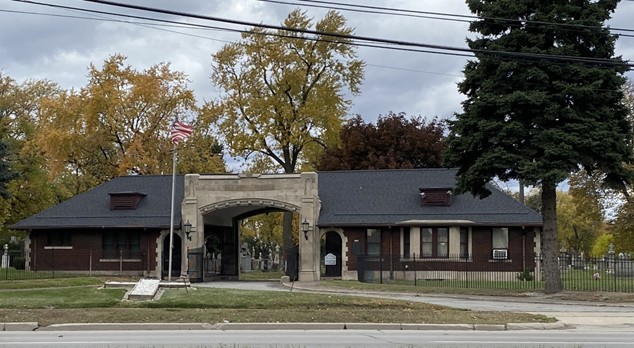
On this past August 23, people gathered, maybe 75 or so, to celebrate mass in a cemetery chapel. The faithful reflected a diverse community: toddlers through seniors, European and Hispanic. Whatever their background, they were there to celebrate and to remember. The focus of the event was the 175th anniversary of the opening of Holy Cross Catholic Cemetery on Detroit’s southwest side. (Photo 1) This consecrated ground, while not having the notoriety of places such as Mt. Elliot, Mt. Olivet, or Elmwood, was an important place for Detroit’s west side Catholic community. That community was integral in providing the backbone for Detroit’s late 19th and early 20th century industrial explosion. These were the people who found that the streets of America weren’t paved with gold, and mostly, in fact, weren’t even paved. They would have to do the paving.
Holy Cross’s roots are more historic, organic, and downright interesting than those of its better-known counterparts. In 1784, Quebec Governor Frederick Haldimand established the Detroit area as a ‘settlement district’ for displaced British loyalists – the fact that Detroit was actually owned by the United States seemed not to be an issue for him.[i] Here enter the Dicks (or Dix) family. As far as can be determined, the Dickses were not British loyalists but colonists who had migrated west from New England in the early 1780s, following the stability brought by the presence of American soldiers as the new country began to exert its influence in its new territory. Jacob Dicks and his growing family took their flatboats along the Lake Erie shore and eventually reached Grosse Ile, where their daughter, Sarah, was born in a tent on January 12, 1785. These Dickses were made of stern stuff. Jacob eventually moved up the Rouge River sometime between 1789 and 1793, taking up a claim consisting of just under 250 acres near Baubee’s Creek.[ii] Their home became the center of what became known as the Dix Settlement, which, at its height, consisted of thirty families. The settlement, like most villages, laid its dead to rest in its village burying ground, which encompassed about 2 acres. Jacob Dicks was interred there in 1805, and many of his friends, relatives, and neighbors were laid there as well.[iii] The establishment of Holy Cross Cemetery at its location is predicated upon the past existence of the Dix Settlement Cemetery at the same site.
By the 1830’s, it was recognized that a permanent Catholic presence was needed to serve the growing Catholic faithful west of the city of Detroit. To that end, Fr. Vincent Baden of Ste. Anne’s Church established the Holy Cross Mission at the Dix Settlement in what was then Springwells Township on June 16, 1835.[iv] The log mission hosted masses when priests were available, although it was not officially classified as a parish and had no resident clergy. Burials in the churchyard next to the chapel started in 1838 if not earlier, but the 2-acre cemetery was not dedicated until 1840. All interments from this period were in what is now called Section B, with the oldest recorded grave dating from 1849.
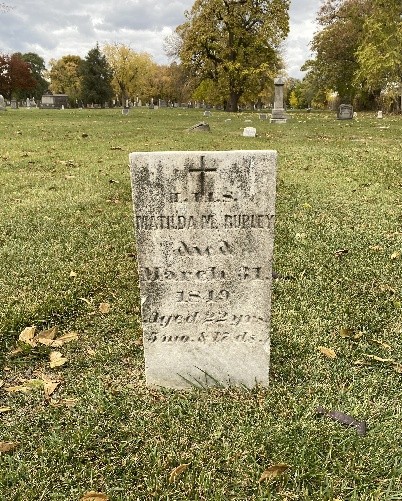
There was no central system for maintaining plot purchase and burial records until after the Civil War, so the location and identity of many of the early interments are lost to history.[v][vi]
The Diocese of Detroit eventually recognized that the immigration-driven growth of the west side of the city necessitated the opening of a larger cemetery for the area’s faithful. At the time, the diocesan Catholic cemeteries in the city were Mt. Elliot and Mount Olivet, both located several miles distant from the burgeoning west and its heavy industry. To this end, Bishop Foley formed a committee for the incorporation of a new cemetery using the existing grounds of the Holy Cross Mission graveyard.[vii] (Photo 3)
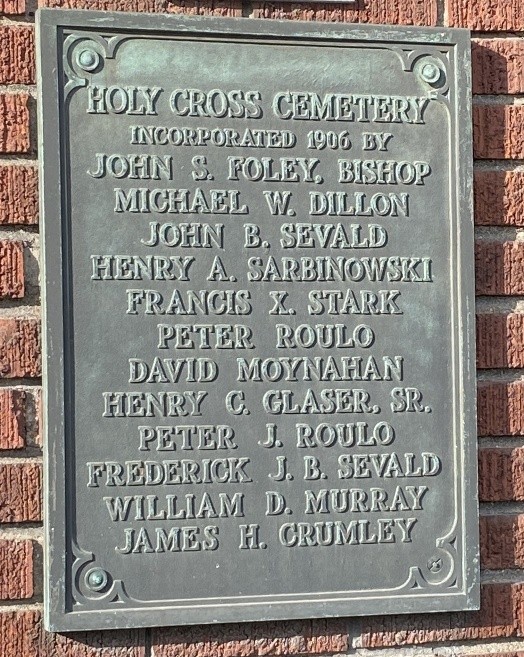
Through 1905, the board worked to acquire additional property, resulting in an expansion of at least 20 acres.[viii] The New Holy Cross Cemetery was officially incorporated on March 23, 1906, and planned to open on All Souls’ Day, November 2. Unfortunately, the recently relocated chapel (the former mission) burned to the ground, destroying precious records and artifacts from the early days of the property, delaying the dedication. Finally, on May 30, 1907, Decoration Day, the newly reconstituted Holy Cross Cemetery was officially opened, although the site itself had been the final resting place for people from Springwells for well over 50 years.[ix][x]
In its early years, Holy Cross was similar in layout and amenities to cemeteries constructed during the rural cemetery movement of the 19th century. These cemeteries, Holy Cross included, were designed as park-like green spaces that were meant to be a source of family relaxation and enjoyment. With the passage of time, however, the plan originally put forth by the board to develop the “largest and most beautiful Catholic cemetery in the nation” was incrementally abandoned[xi]. This was potentially due to a myriad of factors. The use of cemeteries as park spaces declined in the 20th century due to the development of city parks – having Baby Creek Park (opened in 1920 and now called Patton Park) directly across Dix Avenue could not have helped Holy Cross attract visitors seeking recreation. Additionally, the cost of maintaining a rural cemetery is significantly higher than other styles – the continuous planting and replanting of flowers and other foliage drives up continuing expenditures and could impact the affordability of interment for the people of humble economic status that it primarily served. Over time, the pathways and other decorative touches in Holy Cross were removed as additional space for burials replaced them, and by the 1940s, additional property was acquired, expanding the cemetery to its current 65 acres.
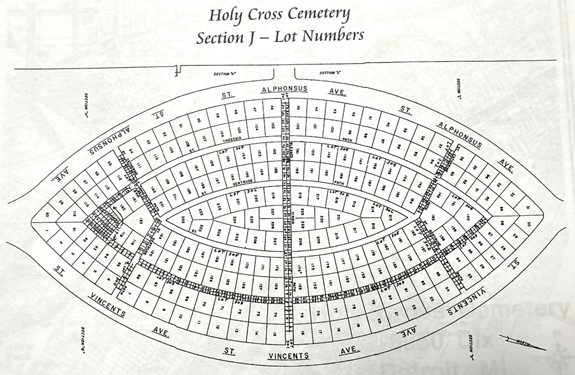
It is fully in keeping with the southwest side of Detroit’s history of heavy industry that the primary neighbor of Holy Cross was first one of the area’s many brick yards, succeeded by the massive slag heaps of the Edward Levy Company.
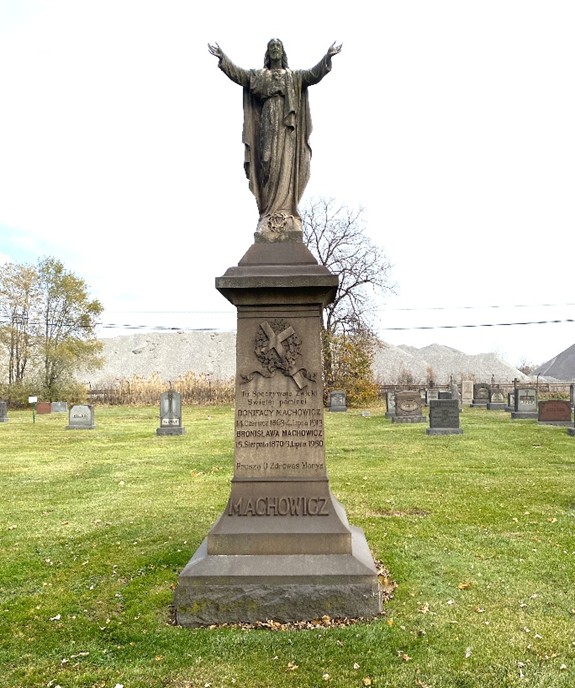
Levy started as a teamster but kicked off his company’s growth through a handshake deal with Henry Ford to remove industrial slag from the nearby Rouge plant’s steel mill and convert it into a rock-like material, which is used in projects such as road construction.[xii] The only constant through all the years of change for Holy Cross has been its mission to serve as a final resting place for the faithful in this historically working-class area driven by the engine of industry that brought the world to Detroit.
End of Part 1
About the Authors
Gavin Swantick is a local historian with several articles published in magazines such as Michigan History. He has a master’s degree in Anthropology from Wayne State University and has worked in many local museums.
Steve Swantick is a retired automotive engineer who grew up on Woodmere Avenue in Southwest Detroit. He has a strong interest in local history and genealogy, and has been fortunate to collaborate with his son, Gavin, on several projects.
[i] Woolworth, Nancy. “Dearborn’s First Pioneers 1780-1796.” The Dearborn Historian 4, no. 1, Winter 1964. p. 8
[ii] Diehr, Eloise Kelly. “The Dix Family.” The Dix Family. Accessed November 18, 2025. http://freepages.rootsweb.com/~jmsfam/genealogy/Dix/The Dix Family by Eloise.pdf
[iii] Diehr, Eloise Kelly. “Descendants of Jacob and Johanna Dicks.” The Dix Family. 18 Apr. 2013, freepages.rootsweb.com/~jmsfam/genealogy/Dix%20index.html.
[iv] Paré, George. The Catholic Church in Detroit, 1701-1888. Detroit: Published for the Archdiocese of Detroit by Wayne State University Press, 1983. P. 413
[v] Raymo, Elaine Walters. Detroit’s Holy Cross Cemetery. Charleston, SC: Arcadia, 2009. P. 7
[vi] “Holy Cross Cemetery.” Detroit Polonia, July 16, 2017. https://www.detroitpolonia.org/holy-cross-cemetery/
[vii] Raymo, p. 8
[viii] “Suburban Siftings.” Detroit Free Press, August 4, 1905.
[ix] Raymo, p. 8
[x] Detroit Polonia
[xi] Raymo, p. 40-41
[xii] Smith, Heather. “Levy Joins the Michigan Construction Movement.” Blog, February 12, 2021. https://blog.michiganconstruction.com/edwclevy#:~:text=Edw.,protecting%20the%20world%20around%20us.