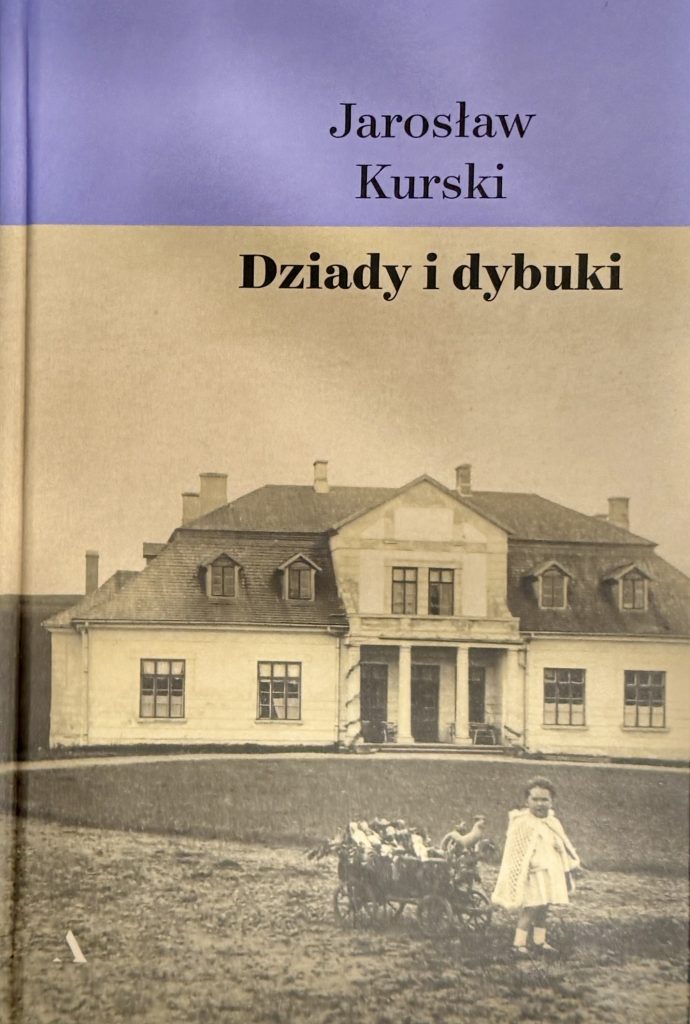
Jarosław Kurski’s “Dziady i dybuki” (“Forefathers/Spirits and Dybbuks”, 2022) is so much more than a captivating family saga. This important contribution to an understanding of the complex and equivocal “Polish identity” is also a fascinating personal story of discovering a part of one’s ancestry. A part deliberately hidden from the author – born in 1963 – by family members, especially by his mother.
The tale of Kurski’s family immediately pulls you in and you read about his mother, as well as his distant and close relations as if they were your own long-lost relatives. It is excellent and powerful storytelling, based on intimate personal memories, conversations and letters, and on published historical research. On both sides of the family, Polish and Jewish, we are introduced to prewar landowners, engineers building Gdynia, university professors, doctors, researchers and discoverers, as well as fighters for Polish independence. Among them are survivors of the Holocaust.
Who do we usually picture when we think about Polish Jewish Holocaust survivors? Kurski’s own, “personal survivors” were first his mother Anna, a Catholic, her mother Teodora, a Jewish convert to Catholicism, and Anna’s sister, his aunt Klara. Their gripping stories of almost miraculous survival, verging on heroism, are a very memorable part of the book. In the dark times of WWII, these practicing Catholics and patriotic Poles, due to their Jewish roots, were in constant danger of being exposed by somebody who knew about the family’s past. Years of keeping secrets and hiding took an immense toll on them. Kurski mentions, for instance, how long after the war his grandmother Teodora, otherwise very collected and lady-like, would wake up at night screaming “He is at the door! Pay him off!”.
Kurski’s Polish grandmother Wanda is one of many in the gallery of fascinating characters conjured up in the book. Wanda grew up in Skierniewice in the poor family of a railway worker. Ambitious, talented and hardworking, she graduated prior to WWII in math and even won Warsaw University’s championship in kayaking. Her brother Zygmunt Adamski, an engineer who worked on constructing the port of Gdynia, her husband Longin, who fought in the 1920 war and in WWII, was a POW and after the war became a professor at Gdańsk Polytechnic, her sister Lunia – also make brief, nevertheless, memorable appearances in the book.
Even such events as his grandmother Wanda’s harsh disciplinary measures which he endured at the age of seven, or his problems in grammar school due to undiagnosed dyslexia (a condition not really known at the time) are treated by Kurski with a degree of kindness and tenderness, which comes with maturity, temporal distance, wisdom and an understanding of one’s own and others’ limitations. With excellent factual and psychological knowledge, as well as some ironic distance, the author weaves a vivid, often suspenseful narrative which is a sheer pleasure to read.
Jarosław grew up learning a lot about the Polish side of his family. It was quite easy as his paternal grandparents also lived in Gdańsk. In addition, his mother Anna, an ardent Polish patriot, eagerly recalled the history and glorious patriotic legacy of her father’s family (the Modzelewskis) going back seven generations, took her sons on trips to their ancestorial villages, yet she – until one fateful day – did not talk about her mother’s family at all.
Jarosław found out about his Jewish ancestry at the age of 27, when his Jewish maternal grandmother Teodora had already been dead for 21 years.
Kurski’s prolonged quest for knowledge about his Jewish ancestors in a way parallels the narrative of Poland rediscovering its shared Polish-Jewish history. Especially during the first two decades after 1989, when Jarosław Kurski wrote the bulk of his book, a lot was published on this subject.
As Kurski states early in his book, his assimilated Jewish ancestors, during the span of three generations, built their Polish identity and distanced themselves from their Jewish identity. In 1910 his maternal great grandfather, a landowner Józef Bernstein (1858-1922), his wife Anna (nee Sommerstein, 1868-1941), and daughter Teodora (1887-1969), converted to Catholicism and changed their name to Niemirowski. This conversion was vehemently resisted by Józef’s son, Ludwik (1888-1960), which caused a big riff in the family and resulted in Ludwik’s moving to England, where he changed his name to Lewis Namier, became an eminent historian and a prominent British citizen. Ludwik, who was not brought up in Judaism, later embraced Zionism (but not Judaism), denounced his “Polishness” and as an expert on Eastern Galicia even had some influence on the shaping of the Polish Second Republic’s eastern border. The views of Lewis Namier, who grew up on the family estate in Koszyłowce, on the topic of the Polish Eastern border, were based on his own knowledge of the ethnic makeup and the history of the people living there, and that’s why he was against the Kresy (borderlands) becoming a part of reborn Poland. He correctly foresaw the possibility of bloody ethnic conflicts there, a prediction which become a tragic reality during WWII.
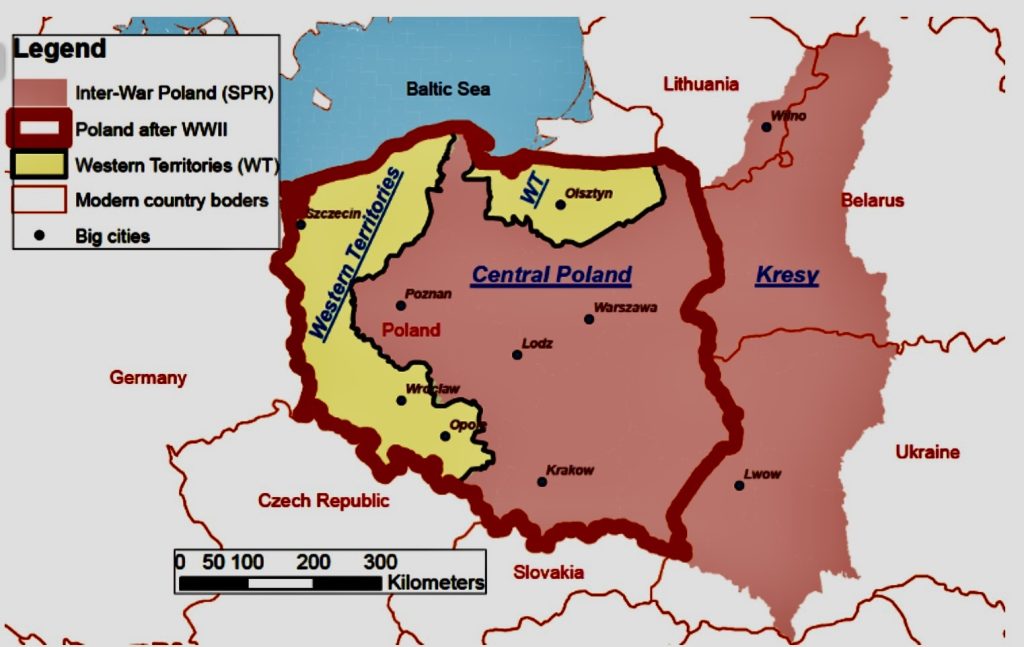
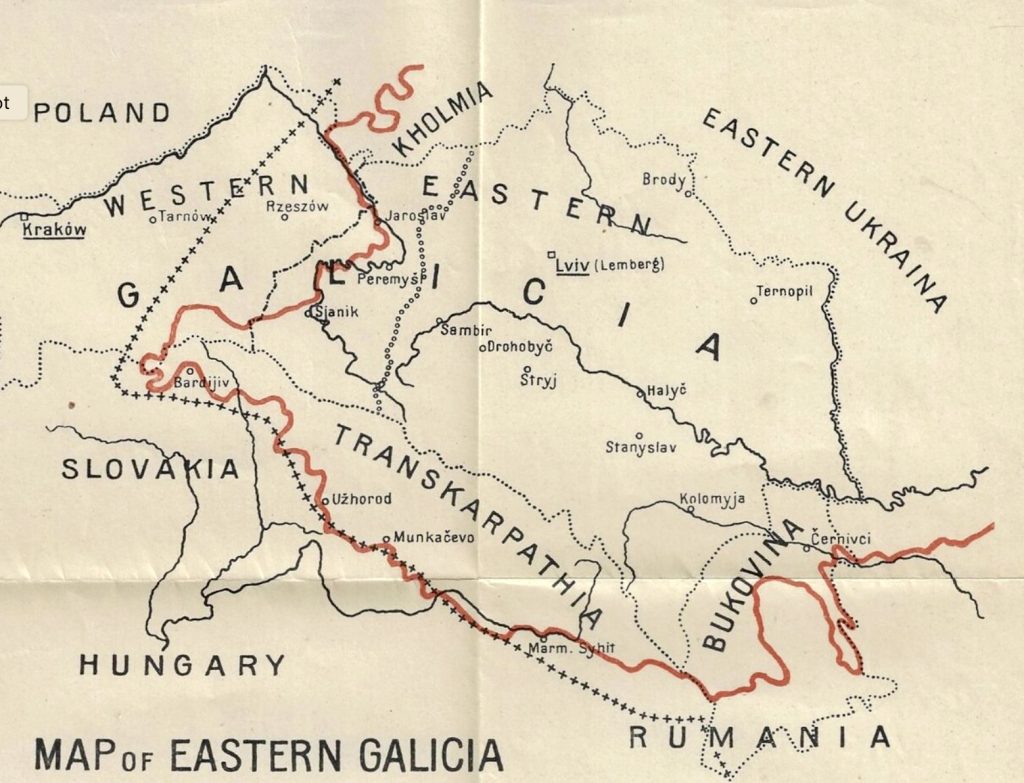
In his opinion, the ethnic majority in a particular geographical area should be the deciding factor in determining to which country an area should belong. According to this logic, Koszyłowce, the family estate Ludwik loved, located in Podolia in Zaleszczyki county, was supposed to become a part of Ukraine (or even Russia), not of Poland. To this end the numbers – with Ukrainians comprising over 60 percent of the population, and Poles 22 percent – offered irrefutable argument.
Ludwik’s attitudes and activities were perceived by his assimilated family as treason against Polishness and the Polish cause and resulted in Ludwik’s being disowned by his father.
In the Jewish Encyclopedia under the entry “Podolia” one reads about the “extremely impoverished condition of its Jews”, but not about Jewish manors and landowners, and there were many of them in the region. According to Jerzy Tomaszewski, in 1921 in Poland only 1.6 percent of all estates larger than 50 hectares (app. 100 acres) had Jewish owners, however in some counties of the Stanisławów Voivodship as many as half of large estates were owned by Jews. It would be interesting to learn if Niemirowski’s family estate was counted among them, as at that time the family had already converted to Catholicism.
According to popular understanding, rural Polish Jews either lived in a shtetl, were inn- or shopkeepers, and were rather poor.
This was not the Bernstein-Niemirowski family. They enjoyed the same lifestyle as other well-off landowners did at the time, taking trips to Vienna, Tyrol and Italy. They farmed, travelled to study, “take the waters” or to gamble away parts of their estate (Jarosław’s great grandfather, Józef did that); their children learned languages with the help of German and French nannies and later were educated in universities in Vienna, Lausanne or Great Britain. In a family photo taken in the ‘20s, we see a Sunday dinner at the estate with the local pastor and vicar sitting at the table; in another – the extended family in front of the manor, in yet another, taken in 1936, dozens of Ukrainian women in ethnic attire are attending Jarosław grandfather’s (Tadeusz Modzelewski’s) funeral. We meet hardworking, entrepreneurial and talented people, like the great-grandmother Anna, a very successful grower of fruit trees with a large nursery selling seedlings and seeds to many estates in Podolia.
In 1939 four women, his great-grandmother Anna, age 71 (died in1941), his grandmother Teodora, age 52 (died in 1969), aunt Klara, age 14 (died in 1973) and his mother Anna, age 10 (died in 2016) were forced to leave Koszyłowce. Escaping the Bolsheviks, they found a refuge first in Lviv, then moved to Warsaw, where they felt safer during the war, as nobody knew about their Jewish roots. After the war they ended up first in Olsztyn then in Gdańsk, where Jarosław was born.
The beginning of Jarosław Kurski’s search for his Jewish heritage started in 1990 with a shocking – for him – revelation: his mother, a judge in Gdańsk, to him and others the epitome of Polishness, who as a 15-year-old girl nursed and fed insurgents in the Warsaw Uprising, was indeed Jewish (on her mother’s side). To the 27-year-old Jarosław it came out of the blue: what he thought was “vicious” (sic.!) gossip, spread in an attempt to discredit his mother and him – was indeed the truth.
Kurski starts “Dziady i dybuki” with describing his mother’s reaction to reading the manuscript of his first book “Wódz” (published in Poland in 1991 and in English, under the title “Lech Wałęsa: Democrat or Dictator?”, in 1993). In the middle of a January night, his mother, perplexed and traumatized, stormed into his apartment to ask him to remove from the manuscript one sentence, which he used in the anecdote. What for Jarosław was just an interesting, albeit inconsequential little story, for his mother, was utterly traumatizing. In the anecdote, Jarosław, at the time the spokesman for President Lech Wałęsa, tried to diffuse a situation which had developed after an exchange between President Wałęsa and his advisor, Professor Bronisław Geremek. Geremek, who was Jewish, politely objected to Wałęsa’s provocative anti-Jewish off-hand remarks, which Wałęsa was known to make. In the awkward silence that followed, Jarosław said that in Poland almost anybody could be “accused” of having “non-Polish” descent, hence Wałęsa’s words could offend many of his sympathizers. He finished with: “(Lechu), you remember my mother, with whom you were at loggerheads at the regional board meetings during the “First Solidarity”, because she belonged to the Gwiazdas’ faction. People used to say that she was Jewish, and you yourself believed it to be true as well” (p. 16, my translation).
And this last sentence brought Jarosław’s mother Anna to his apartment at 3 o’clock in the morning and started what became a years-long search for his erased and forgotten ancestry. The author, completely unaware of his mother being Jewish, at the same time was very much aware that in Poland at the time such lineage was undesirable and could be used to discredit a person. Although Jarosław in 1990 would not call it “antisemitism”, one can arguably see it as such.
After his mother’s initial trauma and denial – he quotes her as shouting: “I am not a Jew! I am Polish! Polish! Polish! You don’t know what you are talking about. You did not live through it. You didn’t witness it. You don’t know what antisemitism in Poland truly is!” – she became very interested in his research, helped by sharing her memories, traveled with him to Ukraine to visit the places where she grew up, and followed the developments of his research very closely. However, she made the author promise not to publish his findings when she was still alive. He kept his promise. His mother died in 2016, and her grand, solemn, state funeral with military salutes, officiated by the Archbishop of Gdańsk Leszek Sławój Głódź, was attended by two famous political opponents, Lech Wałęsa and Jarosław Kaczyński. They sat far from one another in the church, mirroring the political division of Polish society.
This division cuts deeply through Kurski’s family, with Jarosław Kurski being in the “Tusk camp”, while his younger brother Jacek (born in 1966), a proponent of PiS and a close collaborator of Jarosław Kaczyński is on the Polish political right, in the opposition to the current government. In the book “Dziady i dybuki” Jacek and the fundamental ideological differences between the brothers are barely mentioned; on a few occasions they are hinted at but never discussed. In this family discord one could see an echo of the split between Ludwik and his family in 1910. Journalism and passionate involvement in the political issues of their respective times are also what both the Kurski brothers and their maternal granduncle Ludwik have in common.
The title of the book, “Dziady and dybuki” merits some discussion. Let’s start with “dziady”. “Dziady” could be understood simply as the archaic form meaning “grandparents”, but we quickly see that author’s intentions go beyond this meaning when at the end of chapter 1 (p. 20) he quotes from Adam Mickiewicz’s play “Dziady, Part II”: “It’s time to open the chapel door. Light your lamps and candles. Midnight has passed, the rooster crows, the horrible sacrifice is over, it is time to recall our forefathers’ history.”
Like Mickiewicz, Kurski references “dziady”, a pre-Christian ritual of symbolically bringing back the departed ancestors but also makes a connection with one of the most important works of Polish literature. Translated into English as “Forefather’s Eve” and consisting of four parts, with “The Forefather’s Eve Part 3” written in the immediate aftermath of the November Uprising of 1830 being the best known and significant of them, “Dziady” has remained relevant for generations of Poles. Some stagings of the play became cultural or even political landmarks. In 1955 the play brought people together after the ravages of WWII, signaled the beginning of the end of Stalinism and offered catharsis after the pain and suffering of both the war and Stalinism. The banning of the play staged by Dejmek in Warsaw in 1967 (demanded by the Soviet embassy, which saw it as anti-Russian and anti-Soviet), first led to student protests in March of 1968, and then to political upheaval with a very ugly, state-sponsored anti-Jewish campaign and the expulsion of many Jews holding high positions in the party apparatus, but also from universities and other places of employment. As a result, in the years 1968-72 over 13,000 Jews left Poland.
When we reflect on this, we see that the “dziady” part of the title does not refer only to the Polish side of Kurski’s family.
The second part of the title is the “dybbuk”. Dybuk” (or “dybbuk”) in Jewish folklore, a disembodied human spirit that, because of former sins, wanders restlessly until it finds a haven in the body of a living person. Belief in such spirits was especially prevalent in 16th–17th-century eastern Europe.
To Jarosław, his interest in unearthing his Jewish ancestry was like an obsession. He was aware of contradicting the will, first of his mother, and then of his Jewish ancestors, who for three generations had put a lot of effort into negating or even erasing their Jewishness and becoming Polish or, like his granduncle Ludwik, becoming English. Going against their will might be ambiguous hence “the dybbuk”, the spiritus movens driving him to do the research and write the book.
A large part of the book is devoted to reconstructing the story of Lewis Namier. It starts with the mention of a mysterious book in English – England in the Age of the American Revolution – which somehow found its way into Kurski’s apartment in Gdańsk, and which for young Jarosław was just another curiosity, like a German faucet with words “kalt” and “warm”. Only while conducting the research of his Jewish relatives, did he learn that its author, Sir Lewis Namier, was his close relative and that the book was a seminal study of English history.
Lewis Namier’s story becomes important for the author for many reasons. Among others, it allows him to settle scores with the political hero of his youth, Roman Dmowski. Jarosław became involved in a dissident political movement when he was still a highschooler. Brought up in a very patriotic household, he joined the clandestine “Młoda Polska Movement”. Its leader was Aleksander Hall, and the ideology of the movement was largely based on the writings of Roman Dmowski. As the mature Jarosław found out, the writings of Dmowski’s which influenced him in his youth were carefully sanitized, leaving out Dmowski’s antisemitism. Diving deep into his Jewish ancestry Jarosław also learned that Lewis Namier was a chief opponent of Dmowski, and that the two had many disputes. We can see another similarity here: Jarosław’s mother, Anna in a similar way, but for different reasons, “sanitized” their family history by omitting her Jewish ancestors.
Not mentioned in the title, but also present in Kurski’s book, is another creature from Jewish folklore, a golem. A golem is a creature formed out of a lifeless substance such as dust or earth that is brought to life by ritual incantations and sequences of Hebrew letters. The golem, brought into being by a human creator, becomes a helper, a companion, or a rescuer of an imperiled Jewish community. In many golem stories, the creature runs amok and the golem itself becomes a threat to its creator.
At times Jarosław describes “seeing” a golem at work when, for instance, part of his mother’s ashes, despite her wishes, are taken to Gdańsk for her funeral. Gdańsk was the city she thought of as the place of her exile and she wished to be buried in Koszyłowce, alongside her father. Jarosław’s says he pried an urn containing some of his mother’s ashes from the golem’s hands and delivered it to her most beloved place on earth, hence albeit partially, fulfilled her will.
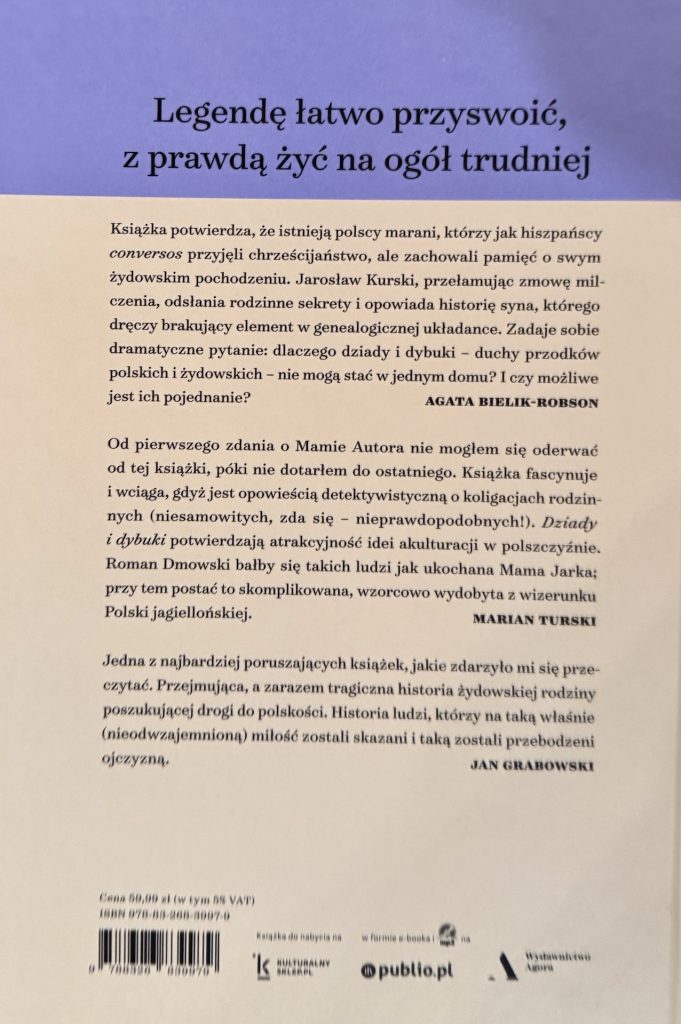
For a history buff and an admirer of good writing “Dziady i dybuki” is a fascinating and a very satisfying book. In her recommendation on the book cover, Agata Bielik-Robson writes: Jarosław Kurski, breaking the family vow of silence, reveals family secrets and tells a story of a son, who is tormented by a missing piece in the genealogical puzzle. He asks himself a dramatic question: why ghosts and dybbuks – ghosts of the Polish and Jewish ancestors- cannot coexist in one house? And is their reconciliation possible?
To this Marian Turski adds: From the very first sentence about the Author’s Mother, I could not pull myself away from this book, until I reached the last one.
Sources quoted:
Jarosław Kurski, Dziady i dybuki, Warszawa, 2022 https://www.jewishencyclopedia.com/articles/12222-podolia#:~:text=The%20Jewish%20population%20of%20Podolia,capital%20of%20Podolia%20is%20Kamenetz%2Dpodolsk.
Alina Molisak, Uniwersytet Warszawski, Żydzi w przestrzeni wiejskiej – żydowskie dwory. Retrieved from: https://dzismis.com/wp-content/uploads/2022/12/Molisak_dwory_Kwartalnik_Historii_Zydow.pdf
Jerzy Tomaszewski, Żydzi w II Rzeczypospolitej, wybór i oprac. Artur Markowski, Szymon Rudnicki, Warszawa 2016, quoted after Alina Molisak
https://www.britannica.com/topic/dybbuk-Jewish-folklore
https://www.jmberlin.de/en/topic-golem
Map of the Eastern Galicia: https://commons.wikimedia.org/wiki/File:Map_of_Eastern_Galicia.jpg
Map of Galicia with historical borders, author: Mix321: https://commons.wikimedia.org/wiki/File:Galicia_map.png
Map showing Kresy:
https://impact.monash.edu/economics/as-they-were-driven-from-their-homes-they-clung-to-one-thing/


