By Frank J. Dmuchowski and Alicja Karlic
The purpose of this article is to present some of the important work and results from the Piast Institute. Tygodnik Polski recently conducted an in-depth interview with Dr. Thaddeus Radzilowski, one of the founders of the Piast Institute. This article presents only some of the major highlights of this fascinating interview.
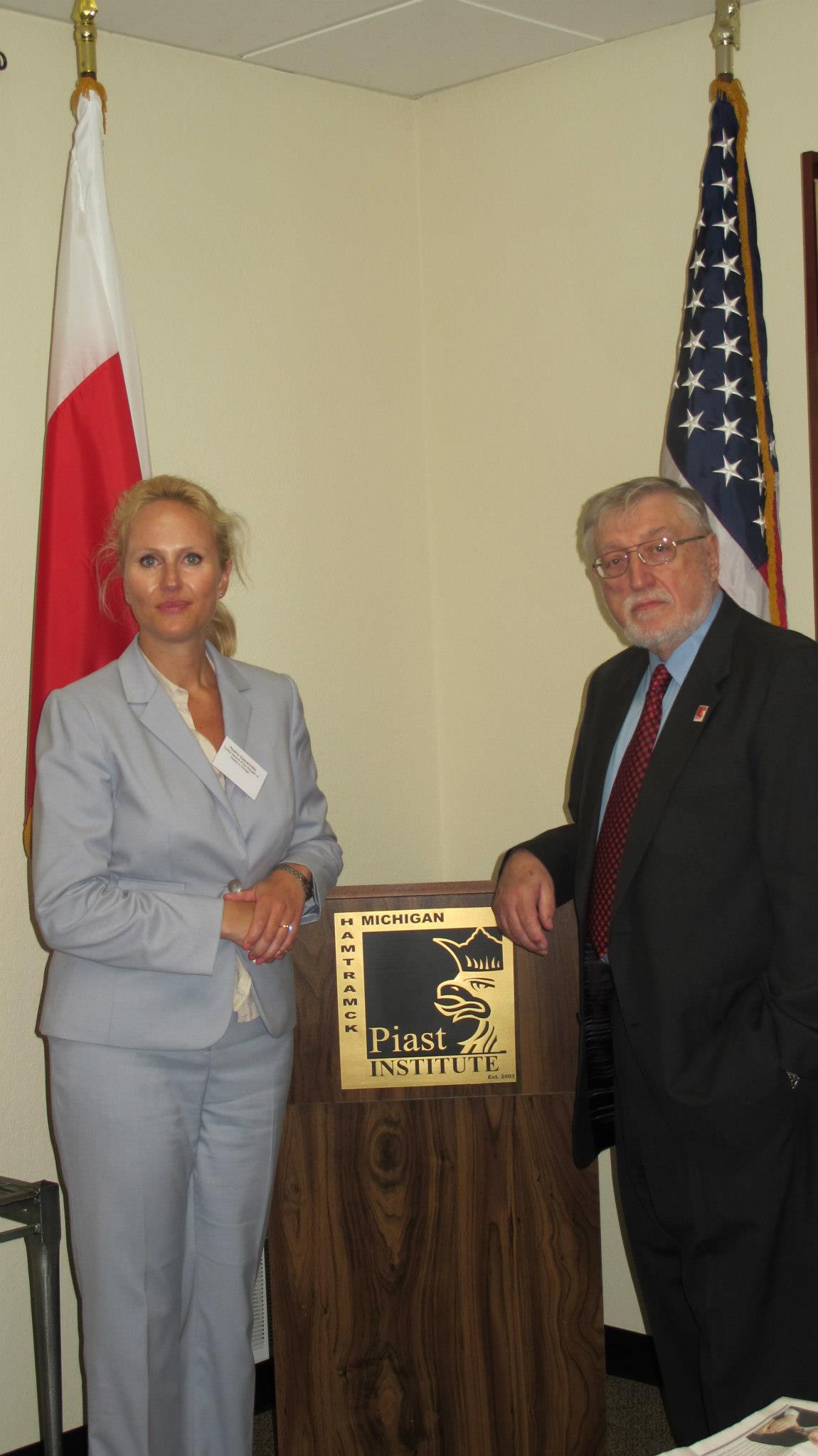
The Piast Institute was co-founded in 2003 by Dr. Thaddeus Radziłowski and Ms Virginia Skrzniarz. The Institute has played an important role in understanding the continuing evolution of Polonia and its relation to the American experience.
At its core, the Piast Institute is a think tank whose mission is to understand the ongoing internal and external evolution of Polonia. The Institute applies this understanding toward its goal of helping to create a new Polonia for the 21st century. The Piast Institute engages with many groups and individuals, including members of Poland’s diplomatic staff, businesspeople in Poland, other researchers, experts in Polish studies, and those involved in American-Polish relations.
Dr. Radziłowski holds a PhD in history from the University of Michigan. Among his prior responsibilities was serving as president of Saint Mary’s College. Ms. Virginia Skrzyniarz was vice president for academic affairs at Saint Mary’s College. She was also the Founder and Executive Director of HOPE Network Southeast. She has extensive experience in working with non-profit organizations and has brought these skills to the Piast Institute.
What is Polonia?
Dr. Radzilowski’s view of Polonia is complex, highly nuanced, yet pragmatic. His ideas are developed with a clear focus on how they can be applied in today’s world. I would like to summarize briefly some of his views below:
First, Polonia is not simply a remnant of Polish culture transplanted here by Polish immigrants. If this were the case, we would not have lasted for over 150 years. The purpose of Polonia was and is not simply to preserve Polish culture and Polish values but to adapt them to American society and, at the same time, try to influence the evolution of American society. He stated that “it is important to appreciate that there is no reason for Polonia to disappear even if immigration from Poland stops completely.”
Second: Polonia is both a community with deep roots in Poland and an integral part of the American reality. We do not talk about assimilating into American society; rather, we talk about moving into an American society that we are creating ourselves. For example, the large presence of Polish immigrants was critical to the success of the labor movement in the United States. In fact, Poles were the largest ethnic group within the labor movement that produced the great CIO unions. Without their courage and initiative, these would never been formed.
Third: Within our view of Polonia and how it relates to the American reality, we are not simply saying that something in America is Polish. Rather, we are saying that there is a significant degree of Polishness and Polish influence in American Society.
Fourth: Because America is like a giant sponge that absorbs everything, we find that Polonia must be continually invented and reinvented as America itself undergoes a similar process. Consequently, we must continually rethink who we are and re-establish our ties to Poland, a major source of our culture that is itself undergoing rapid, ongoing change.
Fifth: We need Poland in different ways at different times, and Poland needs us in different ways at different times. Every generation asks different questions of the past as it seeks to preserve the best of its heritage forever in the new world.
The purpose of the Piast Institute is to constantly rethink how we can be Polonia, how we can be Polish in the American Society in which we live. How can we pass on not just to our generations but to America as a whole the best and most generous ideals of Poland? How can we be vital and relevant in American Society for the next 150 years? There is no reason for Polonia to disappear.
Skills at the Piast Institute
Dr. Radziłowski has a PhD. in history and a deep and abiding interest in the history and culture of Polonia and Poland. As a historian of immigration who served as the National Endowment for the Humanities (NEH) liaison to ethnic groups in America, he draws on the histories and lived experiences of other groups in their encounters with America. He has written over 100 monographs, edited collections, articles, book chapters, and papers. He has also done research for films. One of the films for which he was a researcher and consultant, Out of Solidarity: Three Polish Families in America, won the Prestigious CINE Golden Eagle, and a second, a CNN Frontline show on Nazi Gold in Switzerland, won an Emmy for research. Therefore, his primary function is research and analysis.
Ms. Skrzyniarz has critical expertise in the development and administration of non-profits. She is highly capable in supporting organizations with capacity building, legal inventories, and Board Development. She has made contributions to organizations both within and outside Polonia, including those in Michigan, Ohio, and Illinois.
Other skills of the Piast Institute include expertise in Data analysis and the understanding of the U.S. Census. The Piast Institute was appointed an official Census Information Center (CIC) by the Census Bureau. It is the only such center in the United States to study a European ethnic group. The Institute studies immigration in general as well as how Polonia and other immigrant groups fit into American society. The primary interest in obtaining Census data is to understand who we are, where we are, how our Polish society is changing, and how it compares with other ethnic groups.
Two major current projects of the Piast Institute
The Piast Institute has two major projects that are of great importance to Polonia.
The first is to analyze the most recent American Community Survey data to understand transformations within Polonia since the 2000 census. The American Community Survey is a more timely data source that replaces the removal of the ancestry question from the 2010 census.
The second is to establish an internet-based National Action Alert Program. This program would link to a Polonia database and to a site developed by the Congressional Record to alert Polonians to take action on key issues. The Institute is seeking funding to establish and maintain a site capable of generating thousands of messages to Congress and major newspapers within minutes.
For example, if a piece of legislation, such as the Visa Waiver Program, is brought up for discussion or a vote in the House of Representatives or the Senate, participants in the program would be notified. The National Action Alert Program would, within minutes, provide thousands of participants with a list of legislators in their area, talking points, and a letter template that could be easily sent. Something similar could be done for Letters to the Editors of various newspapers. The key to the success of such a program is identifying a group of Poles or Polonia supporters willing to participate and support the effort. Such a potential list of tens of thousands of individuals does not exist today.
The following is a list of some of the topics discussed with Dr. Radzilowski and his thoughts on them, and what some of his research has revealed:
Who is a Polonian?
“Who is a Polonian?” This is the critical question, as it will ultimately shape Polonia’s future, its group dynamics, and its interactions with America’s political and societal structures, as well as those of Poland.
In the 2000 Census, a question on the long form asked: “What is your ancestry?” The respondent was given up to two choices. One conclusion from this question was that an estimated 10 million Americans identified as Polish Americans. What is notable about the answer to this question is that only an estimated 500,000 individuals were themselves immigrants from Poland. The other 9.5 million were born in the United States and represented multiple generations. This says something very significant about the persistence of Polish identification across generations.
The Number of Polish Voters and Its Implications
There are an estimated 6.5 to 7 million Polish American voters. 85% to 90% of Polish Americans who are eligible to vote do so. This is a significant voting bloc. However, no group inside or outside Polonia has been able to effectively harness this potential. Part of the problem is that Poles, in general, are not significant contributors to political campaigns. A second notable point is that Polish groups do not explicitly ask for “something” in return for providing poll support or making financial contributions. The structures and institutions in Polonia to mobilize Polish Americans politically are grossly underdeveloped.
Identifying these voters and leveraging their potential is critical as we move forward. Interestingly for the political establishment, Poles are approximately evenly broken down into Republicans, Democrats, and Independents. With 2012 shaping up to be a critical election year and the likelihood of tight races in key states where Polish Americans represent significant voting blocs, Polish Americans have the opportunity to shape the political and social landscape of America. Eighty percent of all Polish Americans live in 15 states, many of which are “swing” states.
Visa Waiver Program and Its Implications
The lack of a normalized visa waiver program for Poles seeking to enter the United States is significant for both countries. Interestingly, it can be argued that it is in America’s best interest to facilitate convenient access to the United States for Poles.
The primary thesis is that as Poland becomes more comfortable with its status as a “normal country” without physical threats from Germany and Russia, then Poland will develop increasingly sophisticated relationships not only within the European Union but also with other parts of the world. Polish students and other citizens are more likely to go to countries that readily welcome them and provide access to key institutions. In turn, their attitudes and perceptions of the world will be shaped slightly differently over time.
For example, given the current state of affairs with visas, there is a high probability that Poles will become more Eurocentric at the expense of stronger relations with the United States. For the United States and Poland, there could be a reduction in their historic relationship as mutually reliable allies. In particular, the United States could see a reduction in its presence and influence in Europe.
It would also be the case that Poland would lose some of the benefits of a strong, improving relationship with the United States.
Changes in Poland and Implications for Polish Groups
One of the most significant implications for some Polish groups is that as Poland becomes more comfortable with its role as a “normal country,” it is more likely to shift to the center, with only slight tilts to the left or right. In essence, extremist groups whose influence increases during periods of political or economic instability are more likely to be marginalized.
For example, this translates into the need for Polish groups that, in the past, provided strong and relevant opposition to the Soviet Union and Communism to adjust their interactions with today’s democratic Poland. Otherwise, they are likely to become significantly less relevant in a world where Poland has a democratically elected government and where its traditional enemies do not pose an imminent military threat. A world in which Poland and Poles are far more sophisticated and skilled as diplomats, business people, and citizens of the world than they may have been pre-1989, simply because Poland and Poles have had the opportunityto live as a free and independent people.
Groups that wish to continue leading Polonia must adapt to the new reality of a more centralized, democratically elected government in Poland. In addition, they will need to deal with the “newer generation of Polonians who are better educated, more sophisticated, and for whom less than 4% view communism as a viable threat to Poland.
These groups need to change and adapt to a new reality in which America is constantly reinventing itself. Also, modern Poland is contemporary, sophisticated, and increasingly self-assured. It is worth noting that in the 2009 Piast Institute National Polonia survey, respondents strongly supported finding ways to connect Polonia with modern Poland and Polish culture.
Conclusion
Polonia faces new, continually evolving challenges. Polonian institutions that fail to understand and adapt to the new reality will, of necessity, become less relevant in today’s rapidly changing world. The Piast Institute is well positioned to help Poles and Polish institutions of any size navigate this ever-changing landscape and develop adaptive strategies for the 21st century. Century. Change can be uncomfortable. However, failing to recognize and adapt to change can be disastrous.
It was a pleasure to interview Dr. Radziłowski. Unfortunately, space constraints prevent us from presenting more of his carefully considered analysis on several other topics of interest to Polonia.
We strongly encourage Poles to hear, read, and understand the information and analysis that originates from the Piast Institute. At a minimum, it will help you understand the mechanisms of change affecting Polonia internally, its relationships in America, and, finally, its relationships and potential with a modern, contemporary Poland.
The interview was published on June 21 in 2011.