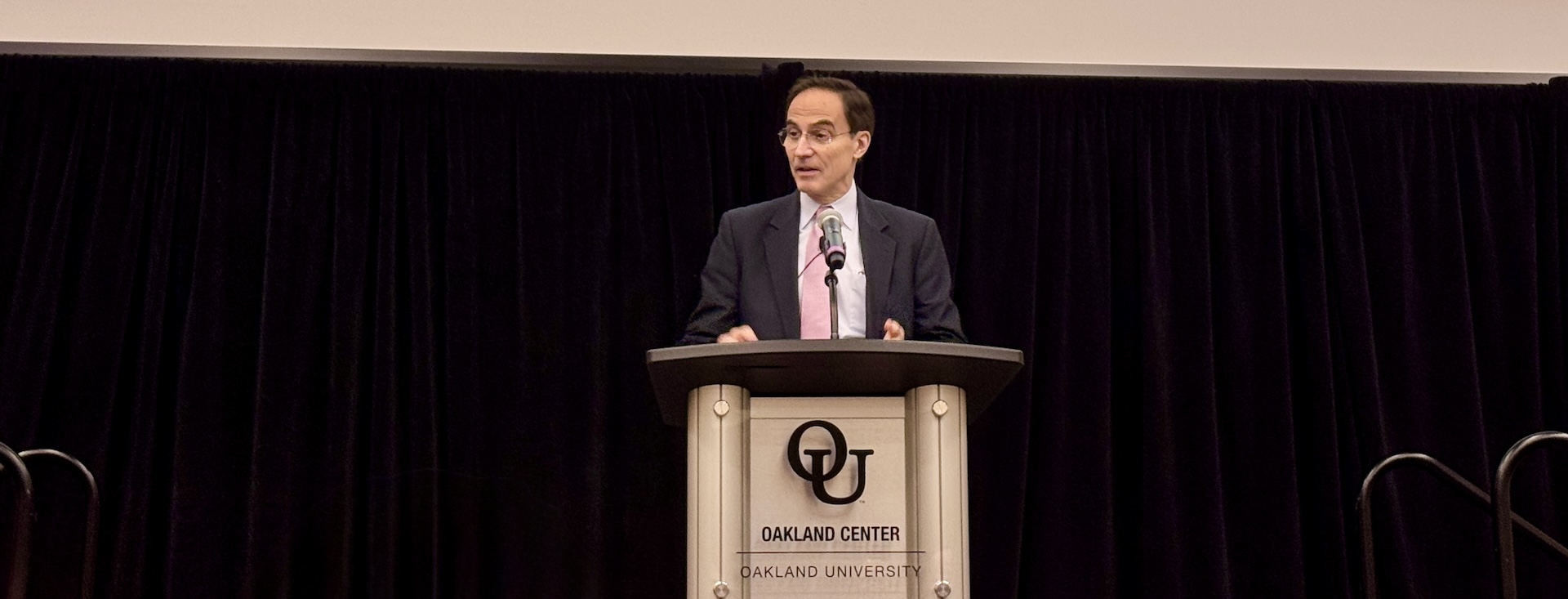
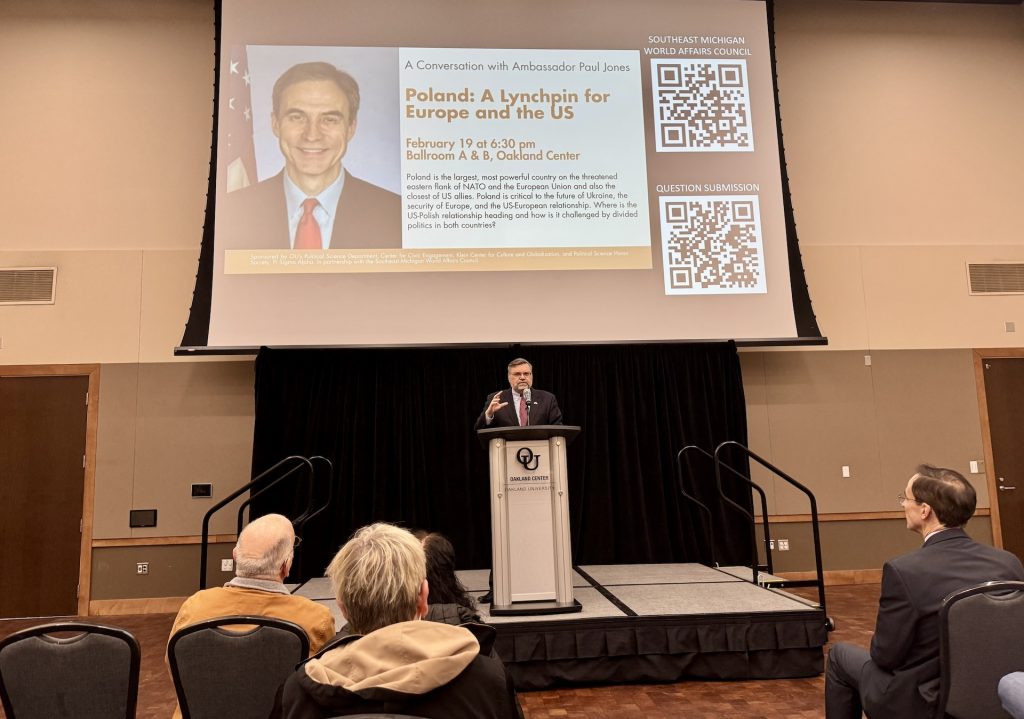
“Poland: a Lynchpin for Europe and the US” was the title of a talk given by Paul Jones, former Ambassador to Poland, on Thursday, February 19 at Oakland University.
Lynne Partington, Executive Director of the Southeast Michigan World Affairs Council, the event organizer, opened the event by asking the audience about the phrase “That’s the way it is”, the signature sign-off used by Walter Cronkite, the anchor of the CBS Evening News in1962-1981. This served as a reminder that we live in a very different era, marked with misinformation and confusion. In such times “face-to -face” meetings, like the one with Ambassador Jones, an expert on Europe and Asia, a former career diplomat with 33 years of experience, are particularly valuable to anyone seeking the truth and wanting to advance their understanding of the world.
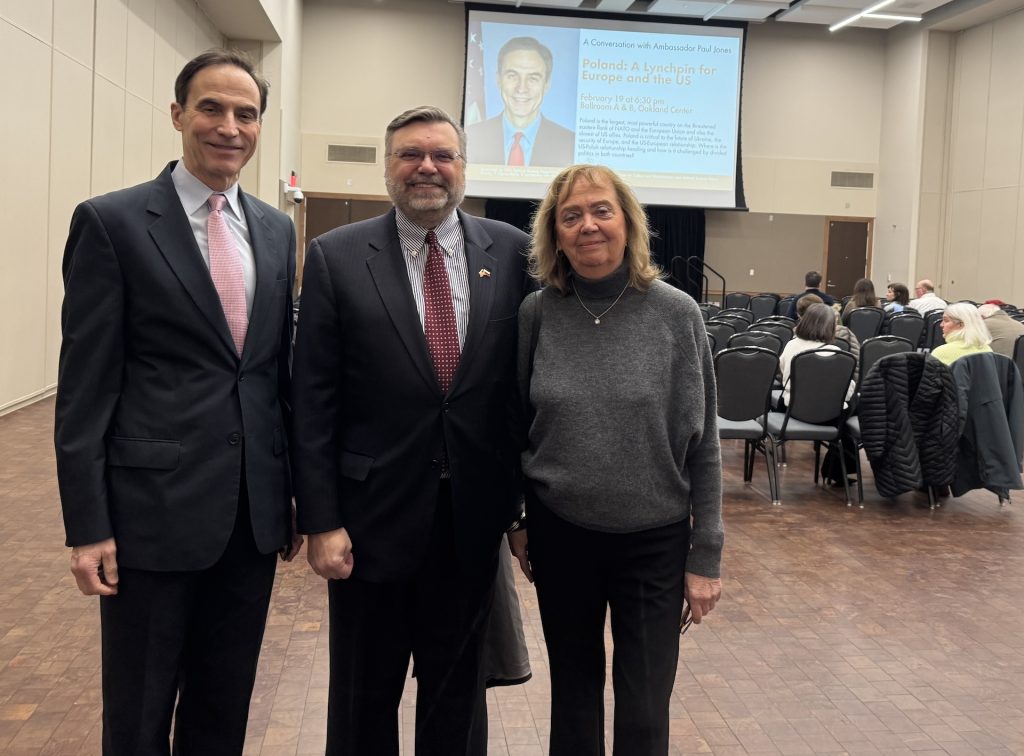
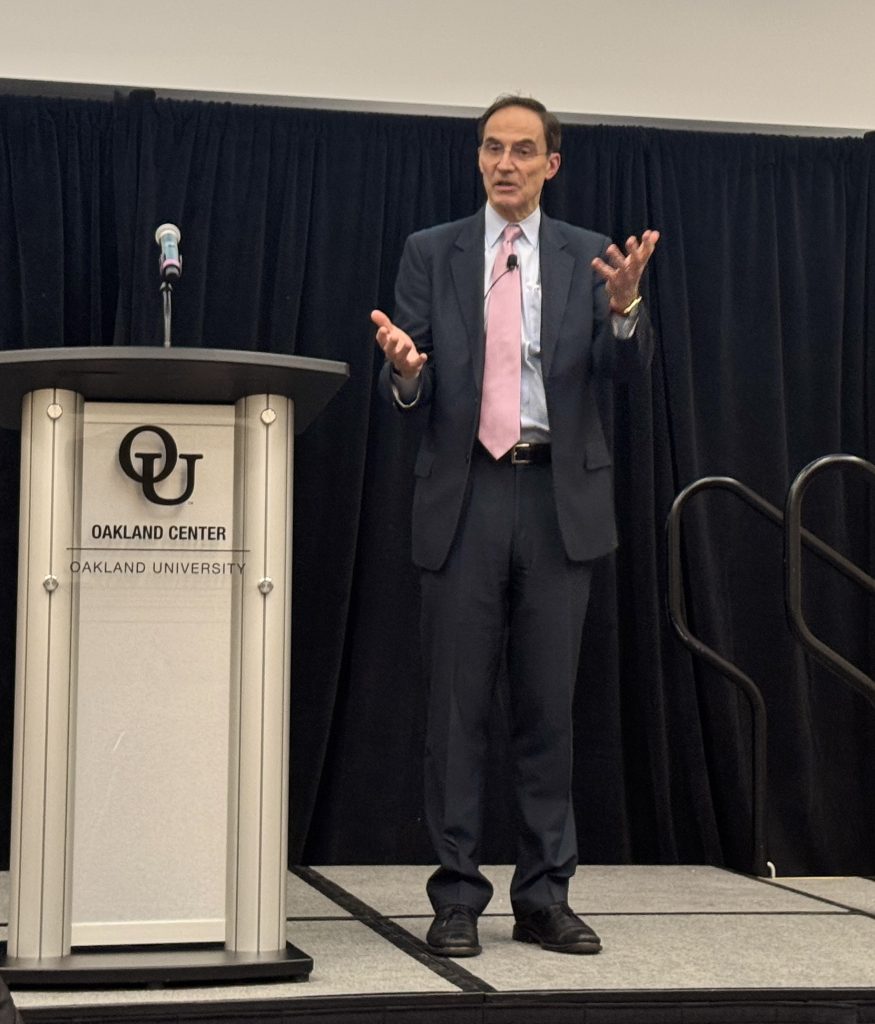
The honor to introduce the speaker fell to Richard Walawender, the Honorary Consul of the Republic of Poland in Detroit, and a brand-new member of the Southeast Michigan World Affairs Council.
In his short introduction Mr. Walawender mentioned the 250-year-long history of relations between Poland and the USA, the important contributions of generals Kosciuszko and Pulaski to the American Revolution and – more recent – Poland’s belief that NATO and the USA would assure its security once Poland became a member in 1999. This belief was recently undermined and is being put to the test by President Trump’s administration.
Before “getting down to business” Ambassador Jones fondly spoke about his close personal ties to Poland, through his wife, whose mother emigrated to the USA from Poland in 1921 as a “gymnastic dancer”. The Ambassador and his family used their three-year-long stay in Poland (2015 – 2018) to reconnect with their Polish relatives and establish close and lasting ties with them.
In the talk that followed the Ambassador also mentioned “the heroes of two continents” and their US accomplishments, then briefly discussed how Poland throughout its history defended Europe and its ideals, became a first-class US ally and supported Ukraine in the war against Russia. The first part of the Ambassador’s speech was an excellent albeit concise history of Poland in which he recalled Poland’s strong military tradition and praised the Poles for fighting not only for their country, but also for the universal values of liberty and self-determination, reflected in the motto “for our freedom and yours”.
Two pivotal events in Polish history when Poland defended Europe and its ideals were King John III Sobieski’s military aid to the Habsburg Monarchy at Vienna in 1683 in the fight against the Ottoman Empire, which the Ambassador called “a defining moment for Europe’s cultural and political survival” and the Battle of Warsaw in 1920, which stopped the Soviets’ advance on Western Europe.
According to the Ambassador, Poland’s “dramatic history” shows how much Poles value “democracy, constitutional government, independence, military strength and also understand Russia.” Speaking about understanding Russia, a not so well-known fact is that in 2010 Polish officials warned the US about Russian intentions to invade Ukraine; the warning was not taken seriously at the time.
In 2022, immediately after the Russian full-scale invasion of Ukraine, Poland responded with massive support, accepting millions of Ukrainian refugees and providing significant aid to Ukraine. This response stemmed from both solidarity with their fellow humans and from the fear that if Ukraine fell to Russia, Poland could be next. The Ambassador underlined that the Ukrainian refugees, and there were 3.5 million of them, were housed mostly in Polish homes, not in camps, a huge accomplishment in itself, and that Poland’s financial help to Ukraine, per capita, ranks third after the US and Germany.
In the next part of his talk Ambassador Jones recalled the adage explaining the original purpose of NATO, coined by NATO’s first Secretary, General Lord Ismay: to keep the Russians out, the Americans in, and the Germans down.
Since the establishment of the Pact in 1949, “keeping the Americans in” was understood by the Europeans as the unwavering US commitment to European security. That’s why after the 1989 fall of communism Poland at once announced its desire to become a NATO member. Just recently the nature of this commitment was questioned by the Trump administration, which created a completely new situation for the European countries.
The largest NATO member on the Eastern flank, and a “model ally” as Poland is often referred to in Washington, Poland spends almost five percent of its GDP on developing its military capabilities. Due to this, Poland is on its way to become the most powerful land force in NATO; currently NATO’s largest land force is Turkey.
In a situation where Russia has been already involved in hybrid warfare against some European countries, including Poland (airspace probes, disinformation, election interference, and cyber-attacks), Poland is critically important to strengthening Europe’s defenses.
In the next part of his talk Ambassador Jones discussed how Poland has been dealing with deep political divisions which first manifested themselves exactly at the time when he arrived in Poland in 2015. This was the year when – in May – Andrzej Duda, the populist candidate of the Law and Justice (PiS) party unexpectedly won the presidential elections, and then, in the fall, PiS very decisively won the parliamentary elections. This win was the first win of an “anti-establishment” party in Europe or in the United States, ahead of Brexit (voted on in June 2016) or the first term in office of President Trump (which started in January of 2017). Although after two terms, in 2023, PiS lost the parliamentary elections to a coalition of opposition parties, in the 2025 presidential elections Poles again elected the populist candidate of PiS, which resulted in Poland currently having a so-called “cohabitation” government, with the pro-EU Prime Minister Donald Tusk and President Karol Nawrocki, who is close to the Trump administration, championing different, often opposite ideas about what is good for the country.
Ambassador Jones sees “maintaining bipartisan support in both countries” as most important for American-Polish relations. As hard as it might be in the complicated political situation, it’s being done, and for instance, Secretary Rubio keeps close relations with Prime Minister Tusk, while President Trump primely engages with President Nawrocki. According to Ambassador Jones, in the US, Polish Deputy Prime Minister Radek Sikorski is “an enormous asset for Poland’s engagement across the political spectrum in Washington DC”.
For good mutual relations between Poland and the US it is also very important that both Americans and Poles see themselves favorably, which is the case with Americans having a very positive view of Poland, and ranking it as second to the United Kingdom. Conversely, in the rankings of Europeans’ attitude toward the US, Poles continue to come up as the ones who like the US the most.
At the end of his insightful talk the Ambassador mentioned again the year 2022, when the immediate response to the war in Ukraine elevated Poland’s stature in Europe to “the highest level it’s ever had”. In his opinion, by the year 2024 this changed due to – mostly- the fatigue caused by the prolonged war which this month enters its fifth year.
However, Ambassador Jones sees the recent re-examination of US-Europe relations and the US pressure on Europe to step up its defense as a situation which might help Poland to elevate its role yet again.
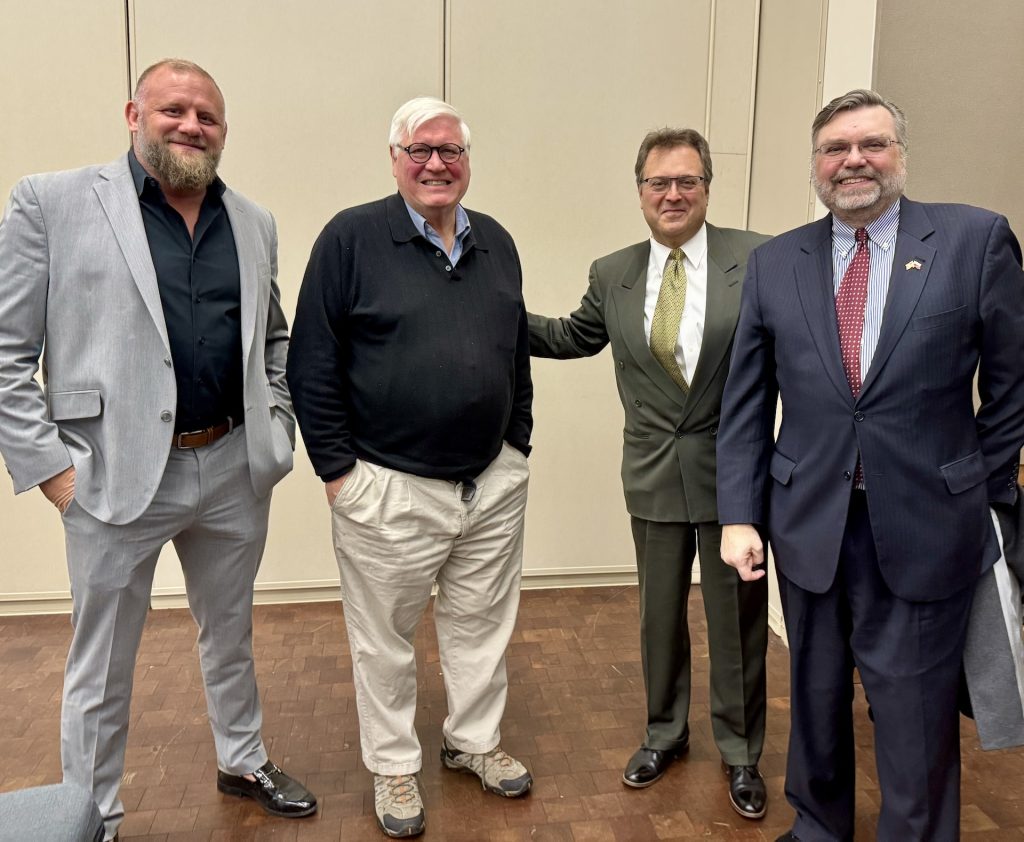
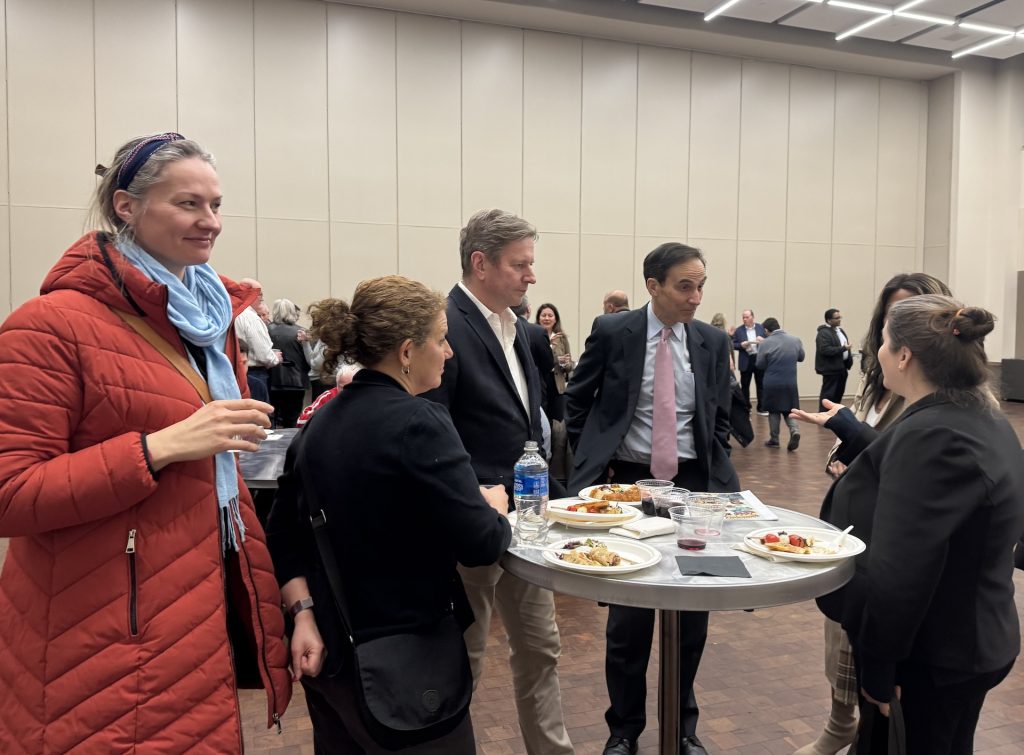
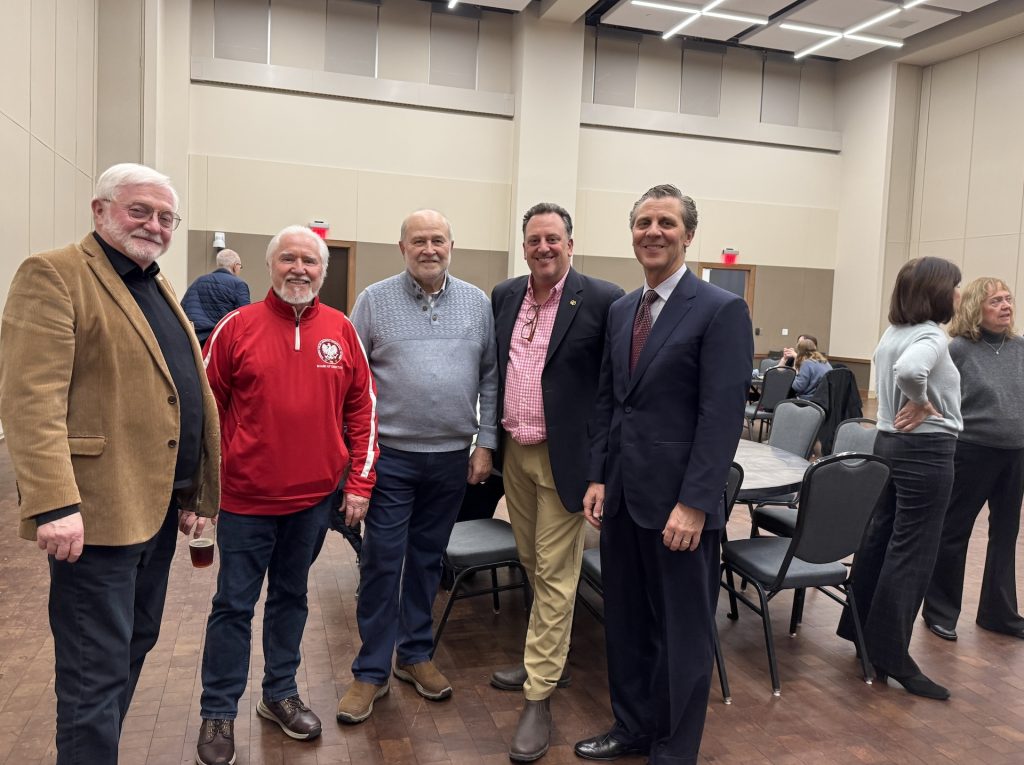
After the talk, Ambassador Jones answered a few questions submitted earlier by the members of the audience, and then everyone in attendance was invited to a reception, during which he graciously talked to anyone who wanted to engage him in conversation.


