Richard Walawender, Konsul Honorowy RP w Detroit
Panie Komendancie, drodzy weterani, Wielebny Księże, Szanowni Państwo, witam serdecznie.
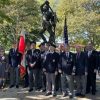
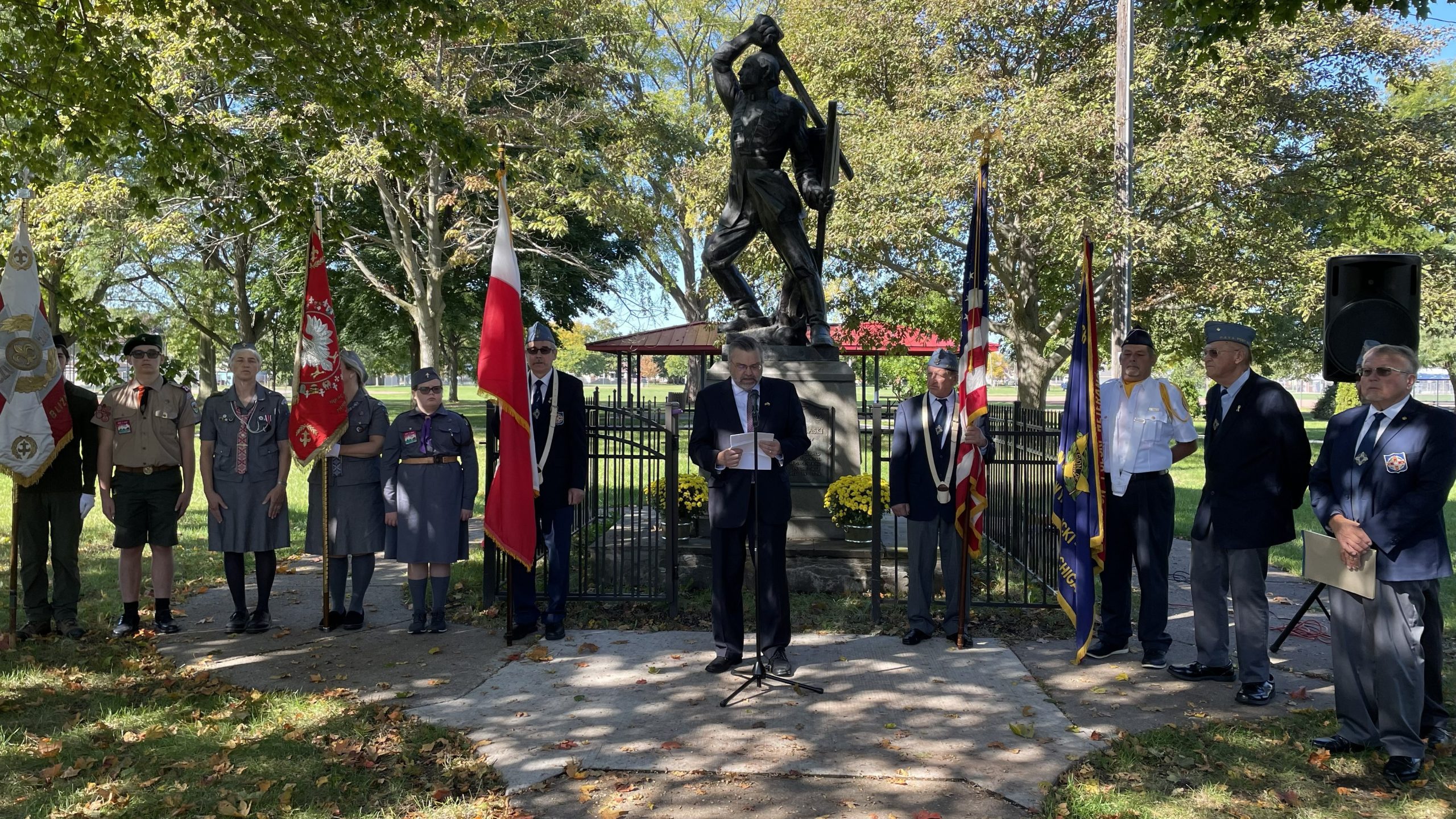
Od lat spotykamy się tutaj, w Parku Pułaskiego, aby oddać hołd generałowi Kazimierzowi Pułaskiemu, bohaterowi dwóch narodów. W tym roku chcę Państwu opowiedzieć o długu honorowym, który jedna amerykańska rodzina zaciągnęła wobec Pułaskiego w dniu jego śmierci, i o tym, jak ten dług został spłacony.
For the past 8 years, I’ve had the honor of speaking to you here, on Pulaski Day.
In the past, I recounted how Pulaski, as a young man in Poland, joined his father and brothers in the Bar Confederation, an armed league of Polish nobles fighting to drive Russian garrisons out of Poland. In the winter of 1770 and 1771, still in his twenties, Pulaski and his men held the monastery of Jasna Góra at Częstochowa against a Russian siege. Shortly after that, the Confederation collapsed, and Pulaski lost his estates and went into exile with nothing.
Pulaski did not give up his fight for freedom. In prior years, I described for you how Pulaski’s reputation as a fierce soldier and leader followed him to Paris, where Benjamin Franklin wrote to George Washington that Pulaski was renowned throughout Europe for the courage he had shown in defense of his country’s freedom. Franklin convinced Pulaski to go to America and join the revolutionary cause there. When Pulaski came to America, he wrote to Washington himself: “I came here, where freedom is being defended, to serve it, and to live or die for it.”
At first, Congress did not give Pulaski a commission, so he fought as a volunteer on Washington’s staff, with no rank and no command. Nevertheless, he became instantly famous when, at the battle of Brandywine, in September 1777, the American line broke, and Pulaski led a handful of horsemen in a counterattack that provided cover to Washington as the Continental Army retreated, which saved Washington and his army. Four days later Congress made him a brigadier general in command of the cavalry, the father of the American cavalry.
I’m sure you remember how, in 1779, Pulaski held the city of Charleston against a far larger British force when others were ready to give the city up.
And then, at Savannah, Georgia, on October 9, 1779, Pulaski led his horsemen through a gap between the British batteries and fell in the crossfire. Major Maciej Rogowski, who rode beside him, knelt over him on the field and heard Pulaski whisper, “Jesus, Mary, Joseph.” Pulaski died two days later.
You surely recall that, shortly after Pulaski died, in 1779, Congress voted to build a monument in his honor, but then forgot about it for more than a century, until Polish-Americans from Toledo found the old resolution and pushed Congress to keep its word. President Taft dedicated the monument in Washington in 1910. In 1929 Congress declared October 11 General Pulaski Memorial Day, and in 2009 it made Pulaski an honorary citizen of the United States, one of only eight people ever so honored.
Last year we proposed to further honor this park, named for Pulaski in 1937, and this statue, sculpted by Ksawery Dunikowski, by applying to list the statue and Pulaski Park on the National Register of Historic Places. Since then the Wyandotte City Council and the City’s Cultural and Historical Commission have both endorsed the nomination, and I’m happy to report that the application to the State Historic Preservation Office has been prepared and is being submitted to the City for review.
Each of those stories recalled what Pulaski gave to Poland and to America. This year I want to tell you about something that came back to Poland because of him. The story begins on the day he fell at Savannah.
One of the American officers who carried the wounded Pulaski from the field was Colonel John Cooper. Pulaski was taken aboard a small ship off the Georgia coast, and Cooper stayed with him until he died. According to the Cooper family, John Cooper made a vow over his friend’s body: if Poland ever again had to fight for its freedom, he or his descendants would come to her aid. The family kept remembering that promise, handing the story down from fathers to sons.
In 1893 Merian Cooper was born into that family in Jacksonville, Florida, and he grew up hearing how his great-great-grandfather, Colonel John Cooper, had fought beside General Pulaski. Merian Cooper became a pilot. In the First World War he flew bombers over France until September 1918, when he was shot down in flames and captured by the Germans. His family was told he had been killed, but he survived.
After the war Cooper joined the American Relief Administration and went to Lwów, bringing food to Polish children in a city still under fire. Poland had just regained its independence after 123 years, and already the Bolshevik Red Army was invading the country from the east. Cooper decided that it was time to fulfill the promise his family had carried since 1779.
So, Cooper went to General Tadeusz Rozwadowski, and then to Józef Piłsudski himself, and offered to organize a squadron of American volunteer pilots, who would fly and fight for Poland. Piłsudski is said to have told him that Poland had no need of mercenaries. Cooper answered that he was not doing this for money. He explained that General Pulaski had given his life for America, and the Cooper family had promised to repay him. Piłsudski accepted.
In the fall of 1919, Cooper and Major Cedric Fauntleroy formed the squadron and named it for the other great Polish hero of the American Revolution, Tadeusz Kościuszko. One of the American pilots, Elliott Chess, designed the squadron’s badge: the red and white stripes and thirteen stars of the American flag, and over them a Kraków peasant cap and two crossed war scythes, the weapons of Kościuszko’s peasant soldiers at Racławice.
Through the spring and summer of 1920, the Kościuszko Squadron flew against the Red Army in Ukraine, scouting, bombing, and strafing its columns, and helped defend Lwów. On July 13, Cooper was shot down behind Soviet lines and spent nearly nine months in a Soviet prison camp. He escaped with two Polish officers, and the three of them made their way some seven hundred kilometers to Latvia, most of it on foot. By then Poland had turned back the Red Army at the Battle of Warsaw. Piłsudski personally decorated Cooper with the Virtuti Militari, Poland’s highest military honor.
By the way, when Cooper returned to the U.S., he went on to Hollywood, and in 1933 he made the movie King Kong. In the final scene of the movie, Cooper himself appears as the pilot of one of the planes that bring King Kong down from the top of the Empire State Building.
Poland’s air force kept the badge after the Americans went home. In 1940, Polish airmen who had escaped occupied Poland to fight on from Britain painted the same emblem on their planes. They were No. 303 Kościuszko Squadron, one of the most celebrated fighter squadrons of the Battle of Britain.
We gather here every October to remember what Pulaski gave. The Cooper family remembered it too. A promise made over Pulaski’s body in 1779 was kept in 1920 by a man born more than a century later, because his family believed that a debt of honor does not expire. That debt passes to us too. As Polish Americans, we owe America our loyalty, and we owe Poland our memory and our support.
I thank the City of Wyandotte for caring for General Pulaski’s statue and this park, and the Polish Army Veterans of Post 95 for keeping this tradition alive, year after year.
Szanowni Państwo, rodzina Cooperów spłaciła swój dług wobec Pułaskiego. Nasz dług, wobec Polski i wobec Ameryki, nigdy nie wygasa.
My, Polonia amerykańska, mamy dwie ojczyzny i wobec obu mamy obowiązki. Ameryka to nasz dom i jesteśmy jej lojalni. Polska stoi dziś na wschodniej flance NATO, a bezpieczeństwo Polski i Ameryki to jedno i to samo. Możemy jej służyć tutaj, przekazując historię Polski naszym dzieciom i dbając o to, by nasz głos na rzecz wolnej, niezależnej i bezpiecznej Polski był głośny i wyraźny oraz docierał do przywódców i przedstawicieli, których wybieramy. Państwo Cooper dotrzymali swojej obietnicy przez sto czterdzieści lat. My też dotrzymajmy naszej.
Za naszą i waszą wolność. Cześć, Jego pamięci!